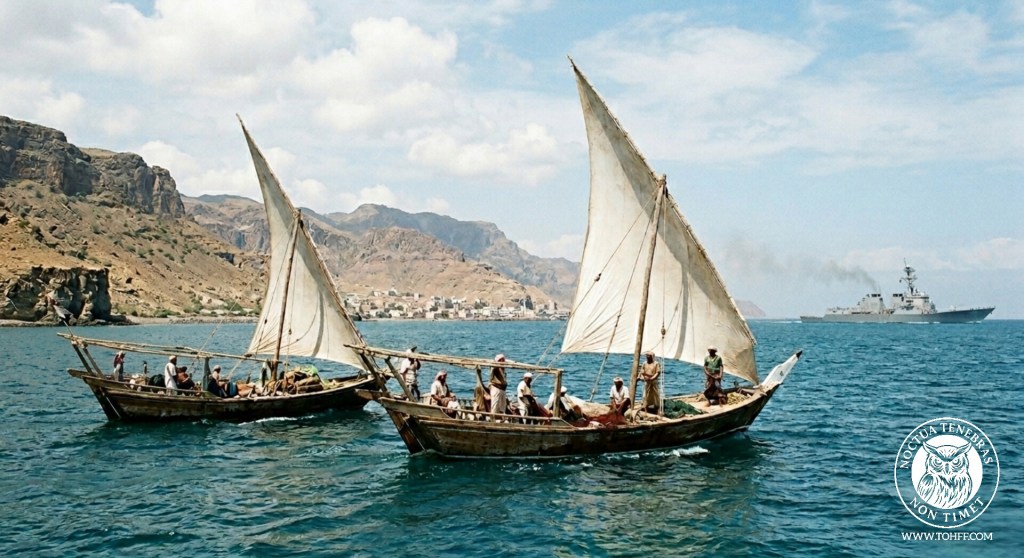
Ancient Maritime Trade Routes and the Infiltration of Illicit Networks. Persian Gulf, Arabian Sea, Red Sea, and western Indian Ocean.
The maritime and overland trade routes connecting the Persian Gulf, Arabian Sea, Red Sea, and western Indian Ocean represent one of humanity’s oldest continuous systems of exchange—over 4,000 years of movement carrying spices, textiles, incense, and cultural knowledge between civilizations in Iran, the Arabian Peninsula, the Horn of Africa, and the Nile Valley. Today, this same ancient infrastructure simultaneously serves as the lifeblood of legitimate regional economies and a primary conduit for transnational illicit trafficking of narcotics, weapons, and people.
This report examines the dual-use nature of these routes, analyzing how low-technology dhows and fishing boats exploit regulatory and surveillance gaps to evade detection, and argues that Human Intelligence (HUMINT) at ports, aboard vessels, and wit3hin fishing communities is not merely complementary to technology but foundational to any effective counter-trafficking strategy. The report maintains a neutral perspective throughout, acknowledging that what external states label “organized crime” or “terrorism” is, for many local actors, an embedded economic necessity, a rational response to grievance, or simply “business as usual” in regions where formal governance is weak.
Key Findings
Historical Legitimacy and Cultural Embeddedness
Maritime trade in this region is not a recent phenomenon but a constitutive element of identity for coastal communities from the Swahili coast to the Persian Gulf. Dhows are cultural symbols, and the networks of trust underpinning this trade—based on kinship, tribal affiliation, and religious brotherhood—predate modern nation-states. This deep social embedding means that traffickers are often insiders leveraging existing relationships and legitimacy to move contraband alongside licit cargo.
Major Illicit Flows
- · Narcotics: The “Hash Highway” runs from Afghanistan and Pakistan through Iran, across the Gulf of Oman, around Oman, through the Gulf of Aden, and up the Red Sea. In 2024 alone, HMS Diamond seized 2.4 tons of hashish valued at £15 million.
- · Weapons: Iran supplies the Houthis via indirect, piecemeal routes using small dhows carrying disassembled missile components hidden among legitimate cargo. Detection depends overwhelmingly on HUMINT.
- · Human Smuggling: Hundreds of migrants drown annually crossing from the Horn of Africa to Yemen; Australia’s Operation Sovereign Borders relies almost entirely on community reporting for interceptions.
The Technical Challenge of Vessel Invisibility
The primary enabler of illicit trafficking is the regulatory gap regarding low-technology vessels. Dhows and fishing boats are largely exempt from AIS (Automatic Identification System) requirements. Even when equipped, AIS can be legally switched off. Operators use forged registry flags, false decks, hidden compartments, disguised cargo, and night-time ship-to-ship transfers to avoid detection. While advanced technology—unmanned surface vessels (USVs), satellite synthetic aperture radar, AI-driven pattern analysis—can identify anomalous movements, it cannot determine intent. Technology provides the what and the where, but not the why.
HUMINT as the Essential Intelligence Layer
HUMINT—information derived from port informants, crew debriefings, community engagement, and undercover operators—is indispensable for:
- · Distinguishing legitimate activity from smuggling cover
- · Mapping criminal and terrorist networks
- · Identifying intent and motivation
- · Providing early warning when technical surveillance is absent
Case examples
- In 2022, a fisherman’s observation in India’s Lakshadweep islands led to the seizure of 218 kg of heroin ($183 million).
- · In March 2021, fishermen’s reports led to the interception of a Sri Lankan vessel carrying 300 kg of heroin and five AK-47s.
- · In February 2024, a HUMINT source in Yemen’s Hodeidah port provided intelligence that allowed a joint U.S.-French naval operation to intercept a dhow carrying 1,200 AK-47 rifles and 500,000 rounds of ammunition.
Regional Dynamics
- · Iran: The primary source of weapons and narcotics, using small dhows with false documentation; HUMINT is extremely difficult due to IRGC surveillance but defectors occasionally provide critical intelligence.
- · UAE: A paradoxical hub—legitimate global trade center and transshipment point for dual-use goods; its Bosaso and Berbera bases serve strategic interests but also facilitate networks supplying Sudan’s RSF.
- · Oman: Vast coastline with limited surveillance; relies heavily on traditional tribal and community reporting.
- · Yemen: Primary destination for Iranian weapons; HUMINT is high-risk but high-value, with local informants providing departure times and rendezvous points.
- · Somalia: Piracy-smuggling nexus; HUMINT from clan leaders and businessmen is essential but conditional on clan interests.
- · Kenya & Egypt: Major transit and consumer points; limited capacity, with HUMINT complicated by cross-border clan ties.
The Blurred Line Between Crime and “Business”
For a fisherman in Puntland, transporting weapons components may be a high-paying job that feeds his family—the cargo’s political purpose is irrelevant. Somali piracy emerged partly from grievances against illegal foreign fishing. UAE strategic resupply of the RSF is, from its perspective, legitimate power projection. The line between licit and illicit is drawn by political interests, not objective moral standards.
Recommendations
- Strengthen Port-Level HUMINT Collection: Establish permanent intelligence liaison offices at key ports (Bosaso, Berbera, Hodeidah, Salalah, Jebel Ali, Mombasa) staffed by experienced case officers. Recruit stevedores, customs officials, and harbor masters as low-level sources with payment and protection.
- Invest in Community Engagement with Reciprocity: Provide tangible benefits to fishing communities that cooperate—better legal fishing enforcement, infrastructure development, health services—to build sustainable trust. Establish formal compensation funds and protection protocols for informants.
- Enhance Crew Debriefing Capabilities: Train naval boarding teams in advanced interrogation techniques. Include civilian intelligence analysts with language skills on naval vessels. Develop a centralized database for debriefing information to identify patterns across interceptions.
- Integrate HUMINT with Technical Intelligence: Use HUMINT to direct technical collection (satellites, USVs, AI) and use technical intelligence to validate HUMINT. Create “fusion cells” where intelligence, law enforcement, and military analysts work together.
- Foster Regional Cooperation: Establish a regional maritime HUMINT sharing framework modeled on intelligence-sharing agreements but tailored to the Gulf and Indian Ocean. Support CMF capacity-building programs and joint training exercises with HUMINT scenarios.
- Address Root Causes: Provide alternative livelihoods through legal fishing enforcement, micro-credit, small business development, and maritime vocational training in coastal communities—drying up the recruitment pool for smuggling networks.
Conclusion
The ancient maritime routes of the Persian Gulf and Indian Ocean are not a security problem in themselves; they are a civilizational asset. The infiltration of these routes by illicit networks is a contemporary challenge built on an ancient infrastructure. Technology is essential for detection but cannot replace the human judgment, context, and network understanding provided by HUMINT.
The most sensitive and versatile intelligence asset in this environment is the human being—the fisherman who knows every hidden cove, the port worker who sees every cargo, the community that, with the right engagement and reciprocity, can become the first and most effective line of defense.
The sea is ancient, and so is the trade upon it. Our response must be equally enduring—and it must be human-centered.
Book on Amazon!
Intelligence Gathering: Front Line HUMINT Considerations
The things I talk about in this book are double-sided; can be used to
target others or used against you.
Audio Book @ https://www.amazon.com/dp/B0DJMW8SM5
Kindle @ https://www.amazon.com/dp/B086WPL4XS
Paper Back @ https://www.amazon.com/dp/B086PN2KLQ
Hard Cover @ https://www.amazon.com/dp/B0FK25TC7D

