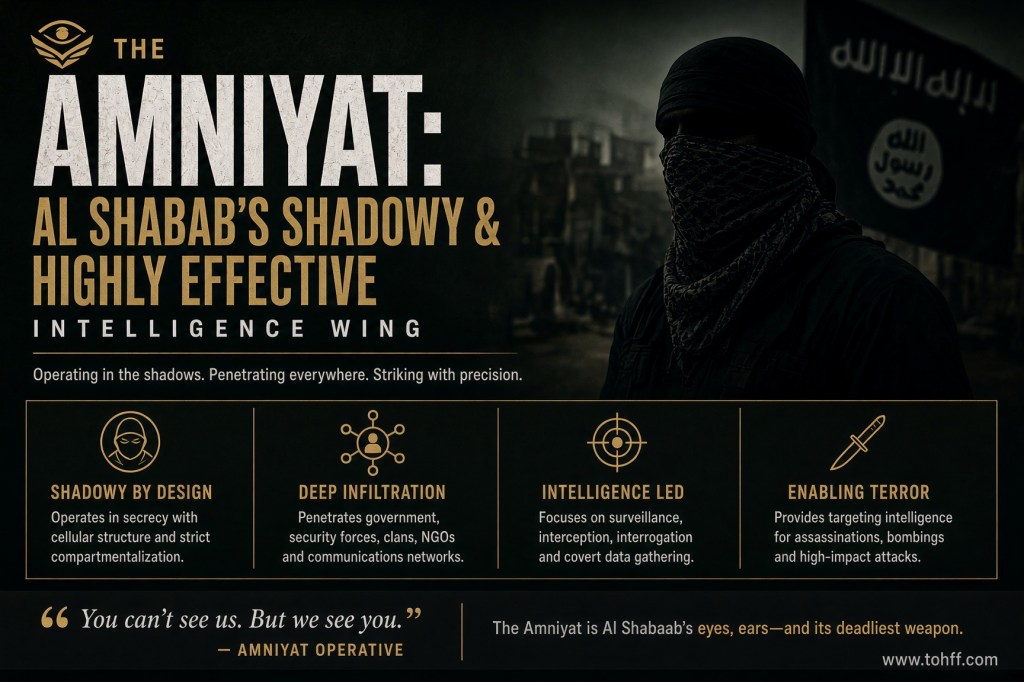
Al Shabaab, the formidable Al-Qaeda affiliate in East Africa, owes much of its resilience to a secretive and highly effective intelligence apparatus known as the Amniyat—Arabic for “Security.” Far more than a simple information-gathering unit, the Amniyat is the strategic brain of the organization. It masterminds assassinations, plans complex attacks, and ensures the group’s survival against internal dissent and external counterterrorism efforts. Its existence and effectiveness are central to Al Shabaab’s ability to project power not just within Somalia, but increasingly across its volatile neighboring states.
Structure: A Decentralized and Fearful Network
The Amniyat’s power lies in its sophisticated, clandestine structure, which mirrors a state intelligence agency to ensure survivability.
Organization and Compartmentalization: The Amniyat operates with a central command but is meticulously divided into regional commands and specialized units. These units operate in isolation, often unaware of each other’s existence—a tactic that provides an extra layer of security. If one cell is compromised, the rest of the network remains intact. This “compartmentalization” is crucial to its endurance.
Specialized Units: Within the Amniyat are distinct squads dedicated to specific functions: intelligence collection, finance and logistics, grenade attacks and assassinations, and suicide operations. These cells are often described as “sleeper cells,” hidden within communities and activated only for specific missions, with operatives receiving additional secret training before deployment. This clandestine nature makes them exceptionally difficult to track and eliminate.
Elite Status and Loyalty: Amniyat operatives are considered the elite of Al Shabaab. They are chosen for their creativity, bravery, loyalty, and ability to keep secrets. They receive specialized training, better equipment, and significantly higher pay, including incentives like mobile phones and even brides, to secure their loyalty. They report directly to the emir of Al Shabaab and are the only force capable of challenging his authority, acting as both his praetorian guard and his instrument of control.
Adaptability and Modernization: Recent developments highlight the Amniyat’s adaptability. Following a 2025 reshuffle, long-serving military commander Yasir Jiis was reassigned to lead a covert Amniyat unit tasked with securing smuggling routes and overseeing a new drone warfare program. This shows the Amniyat’s role in modernizing the group’s capabilities, potentially using drones for targeted attacks across borders.
Tactics: Intimidation, Infiltration, and Information
The Amniyat’s success is rooted in a blend of traditional and modern intelligence techniques.
Human Intelligence (HUMINT): The Amniyat’s primary strength is its deep integration into Somali society and its ability to infiltrate enemy ranks. Operatives embed themselves in communities to gather information and have successfully penetrated Somali government institutions, including the National Intelligence and Security Agency (NISA). This human network is also extended into neighboring countries through ethnic Somali communities and cross-border kinship ties.
Assassination as a Tool: The Amniyat is feared for its assassination squads, which eliminate government officials, defectors, and rivals within Al Shabaab. These assassinations are executed in a manner that ensures even the assassin often doesn’t know who ordered the killing, creating a pervasive culture of fear and paranoia. This atmosphere of intimidation is key to controlling territory and populations.
Counterintelligence: A primary function is to protect Al Shabaab from enemy infiltration. The Amniyat creates a culture of fear and intimidation to root out spies and dissidents, both inside Somalia and among sympathizers in neighboring states.
Open Source Intelligence (OSINT): Beyond traditional methods, the Amniyat has become adept at using open-source intelligence, monitoring social media and other public sources to track enemy movements and recruitment efforts across the region.
The current picture of the Amniyat leadership:
- The Intelligence Chief: Yusuf Ahmed Hajji Nurow, also known as Gees Ade, is identified as the chief of the Amniyat. His role makes him a key figure in the wing’s execution of suicide attacks and assassinations across the region.
- High-Ranking Commander Reassigned: Yasir Jiis is a significant figure who was formerly the commander of Al-Shabaab’s armed wing, the Jabha. However, reports from mid-2025 indicate he was reassigned to lead a covert unit within the Amniyat. This unit is reportedly tasked with strengthening the group’s smuggling corridors and developing drone warfare capabilities.
- Recent Casualty: As of late March 2026, Somali forces reportedly killed Suleyman Omar Fidow, who was described as the intelligence chief and commander of Al-Shabaab suicide bombers. This suggests a potential vacancy or shift in leadership at the very top of the Amniyat’s operational command.
- Other Previous Leadership: You might also come across the name Mahad Karate. He is the group’s deputy emir and retains command responsibility over the Amniyat, but he is not currently listed as its direct head. The 2022 designation of Mustaf ‘Ato also listed him as a senior Amniyat official responsible for attacks in Kenya, but his current status is unclear.
Operations in Neighboring Countries: Exporting Insurgency
While the Amniyat’s headquarters remain in Somalia, its operational reach extends deeply into the Horn of Africa’s most fragile states. These cross-border operations serve multiple purposes: securing supply routes, launching retaliatory strikes, and expanding Al Shabaab’s ideological influence.
Kenya: The Northern Front
Kenya has borne the brunt of Al Shabaab’s external operations. The Amniyat plans and executes attacks through sleeper cells embedded within Kenya’s coastal and northeastern regions, particularly in areas with large ethnic Somali populations like Garissa, Mandera, and Lamu.
- Major Attacks: The Amniyat was the architect behind the 2013 Westgate Mall siege in Nairobi, the 2015 Garissa University attack that killed 148 people, and numerous smaller IED attacks and roadside ambushes along the Somali-Kenyan border. These operations are meticulously planned, often involving years of reconnaissance and the use of Kenyan nationals recruited and trained inside Somalia.
- Recruitment and Logistics: The Amniyat leverages smuggling routes through the porous border to move fighters, weapons, and explosives into Kenya. It also runs a parallel recruitment network, targeting disaffected youth in Kenyan madrassas and coastal towns.
- Counterintelligence in Kenya: The Amniyat has successfully infiltrated Kenyan security forces, enabling it to anticipate and evade counterterrorism operations. It also uses intimidation tactics against Kenyan elders and government officials to discourage cooperation with Nairobi.
Ethiopia: The Western Threat
Ethiopia, with its large Somali region and long, porous border, is another prime target. The Amniyat views Ethiopia as a historical enemy and a key ally of the Somali government.
- Cross-Border Raids: The Amniyat orchestrates hit-and-run attacks on Ethiopian military outposts and convoys, particularly in the Somali Regional State. These attacks are often coordinated with local Oromo and Somali insurgent groups, creating a complex, multi-front challenge for Addis Ababa.
- Securing Supply Routes: The Amniyat uses Ethiopian territory to smuggle weapons, fighters, and contraband, exploiting the region’s instability and weak governance. It also monitors Ethiopian troop movements and communicates intelligence back to Al Shabaab’s central command.
- Psychological Warfare: The Amniyat has claimed responsibility for attacks inside Ethiopian cities, such as the 2022 bombings in Jijiga and Dire Dawa, aiming to demonstrate its ability to strike deep into Ethiopian territory and erode public confidence in the government.
Djibouti and the Gulf of Aden: The Maritime Nexus
Djibouti, home to multiple foreign military bases, is a symbolic and strategic target. While large-scale attacks inside Djibouti are rare, the Amniyat plays a critical role in maritime operations.
- · Smuggling and Piracy: The Amniyat oversees the smuggling of weapons and foreign fighters via small boats from Yemen across the Gulf of Aden. It also coordinates with pirate networks to fund operations and secure sea routes for logistical movements.
- · Surveillance: The Amniyat monitors naval traffic and foreign military installations in Djibouti, gathering intelligence that could be used for future asymmetric attacks or shared with Al-Qaeda’s central leadership.
A Regional Threat That Keeps Growing
The Amniyat is the core of Al Shabaab’s longevity and its ability to export violence beyond Somalia’s borders. Its sophisticated structure, decentralized command, and brutal effectiveness make it a blueprint for modern insurgent intelligence wings. While its primary focus remains the Horn of Africa, its operations in Kenya, Ethiopia, and Djibouti demonstrate a clear intent to destabilize the entire region. With growing capabilities in drone warfare and international logistics, the Amniyat is not just a Somali problem—it is the most significant cross-border terrorist threat in East Africa today.
Book on Amazon
Intelligence Gathering: Front Line HUMINT Considerations
The things I talk about in this book are double-sided; can be used to
target others or used against you.
Audio Book @ https://www.amazon.com/dp/B0DJMW8SM5
Kindle @ https://www.amazon.com/dp/B086WPL4XS
Paper Back @ https://www.amazon.com/dp/B086PN2KLQ
Hard Cover @ https://www.amazon.com/dp/B0FK25TC7D

