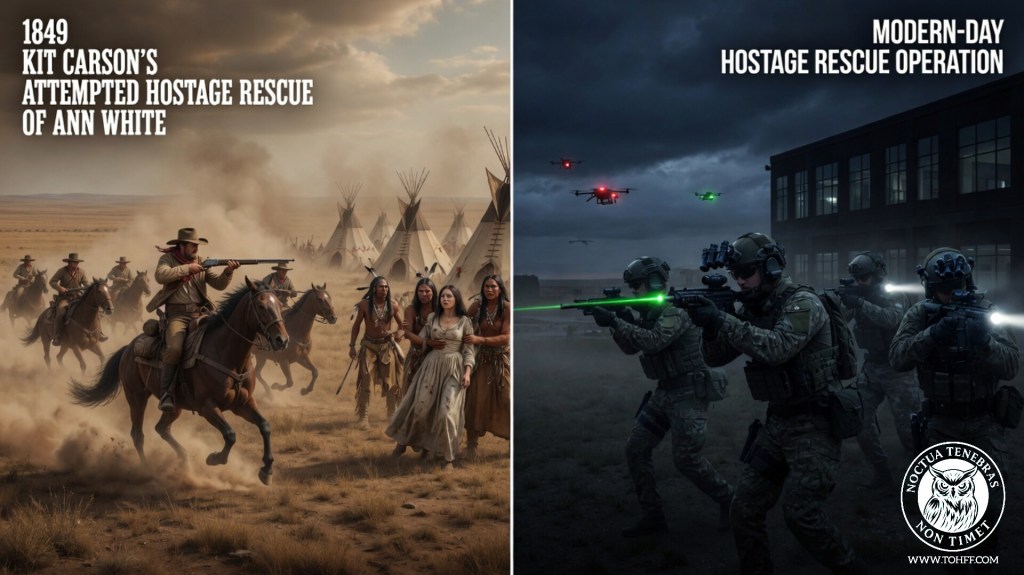
Tragedy on the Santa Fe Trail: Comparing the Kit Carson–Ann White Kidnapping to a Modern Hostage Rescue
The story of Ann White’s 1849 kidnapping and death—and the famous frontiersman Kit Carson’s agonizingly late rescue attempt—remains one of the most haunting ironies of the American West. Though separated by more than 170 years, this frontier tragedy and a modern special‑forces hostage rescue share a common core: a desperate race against time, high‑stakes decision‑making under extreme pressure, and the ever‑present risk that a rescue mission can go horribly wrong. Yet the differences in intelligence gathering, tactical execution, command structure, and the very role of the hostage reveal just how dramatically hostage rescue has evolved from the era of horse‑mounted scouts to the age of drone surveillance and night‑vision goggles.
The 1849 Pursuit of Ann White
In October 1849, James and Ann White, along with their infant daughter and a female servant, were traveling the Santa Fe Trail, a remote and dangerous artery of commerce and migration. Their small party was attacked by a band of Jicarilla Apache and Ute warriors. James White was killed on the spot, and Ann, her baby, and the servant were taken captive. When news reached the U.S. Army, a rescue party was quickly assembled. Among its members was the legendary scout and trapper Kit Carson, already famous for his tracking skills and frontier knowledge.
For nearly two weeks and across roughly 200 miles of harsh New Mexico terrain, Carson led the soldiers in a relentless pursuit. They followed broken branches, hoof prints, and abandoned campfire ashes—forensic evidence of the nineteenth‑century variety. The men pushed their horses to the limit, sleeping little and riding hard. By all accounts, Carson’s tracking was masterful; he correctly predicted where the raiders would stop to rest or water their animals. But no amount of skill could accelerate the mission. Horses tire, rivers must be crossed, and a party of armed men moves only as fast as its slowest mount.
On the twelfth day, Carson’s men spotted the Apache camp. The plan was a classic frontier assault: a swift, noisy charge intended to scatter the warriors and snatch the captives. As the soldiers thundered into the camp, gunfire erupted. The Apaches, surprised but not paralyzed, fled on foot and horseback. In that chaos, one warrior stopped just long enough to draw an arrow and shoot it directly into Ann White’s heart. By the time Carson reached her body, she was still warm. The servant was also dead. The infant daughter was never found, presumably taken or killed during the flight.
The rescue had failed by minutes. For Kit Carson, the worst moment came after the shooting stopped. Among Ann White’s belongings, a soldier discovered a copy of a popular dime novel: Kit Carson: Prince of the Gold Hunters. In its pages, the fictional Kit Carson always arrived in the nick of time to save beautiful women from Indians. The real Kit Carson had to bury a woman who had likely read those very words and believed he would save her. He was reportedly haunted by this irony for the rest of his life.
The Anatomy of a Modern Hostage Rescue
Fast‑forward to the twenty‑first century. A modern hostage rescue operation, such as the 2020 mission to save American citizen Philip Walton in Nigeria, looks nothing like Carson’s pursuit. Walton was kidnapped by armed men who demanded ransom. Within five days, U.S. Navy SEALs parachuted into the country, tracked the captives using electronic intelligence and drone surveillance, and conducted a precision nighttime assault. Six of the seven kidnappers were killed; Walton was rescued unharmed. No American or Nigerian casualties occurred.
The differences begin with intelligence. Instead of tracking hoof prints, modern operators use satellite imagery, intercepted phone calls, drone feeds, and signals intelligence (SIGINT) to pinpoint a hostage’s location to within a few meters. They also deploy human intelligence—local informants, undercover agents, or even hostage‑negotiation specialists who build rapport with captors while gathering data. In the 2012 rescue of Jessica Buchanan from Somali pirates, U.S. commandos learned from multiple sources that her health was rapidly deteriorating, which triggered the decision to assault rather than wait.
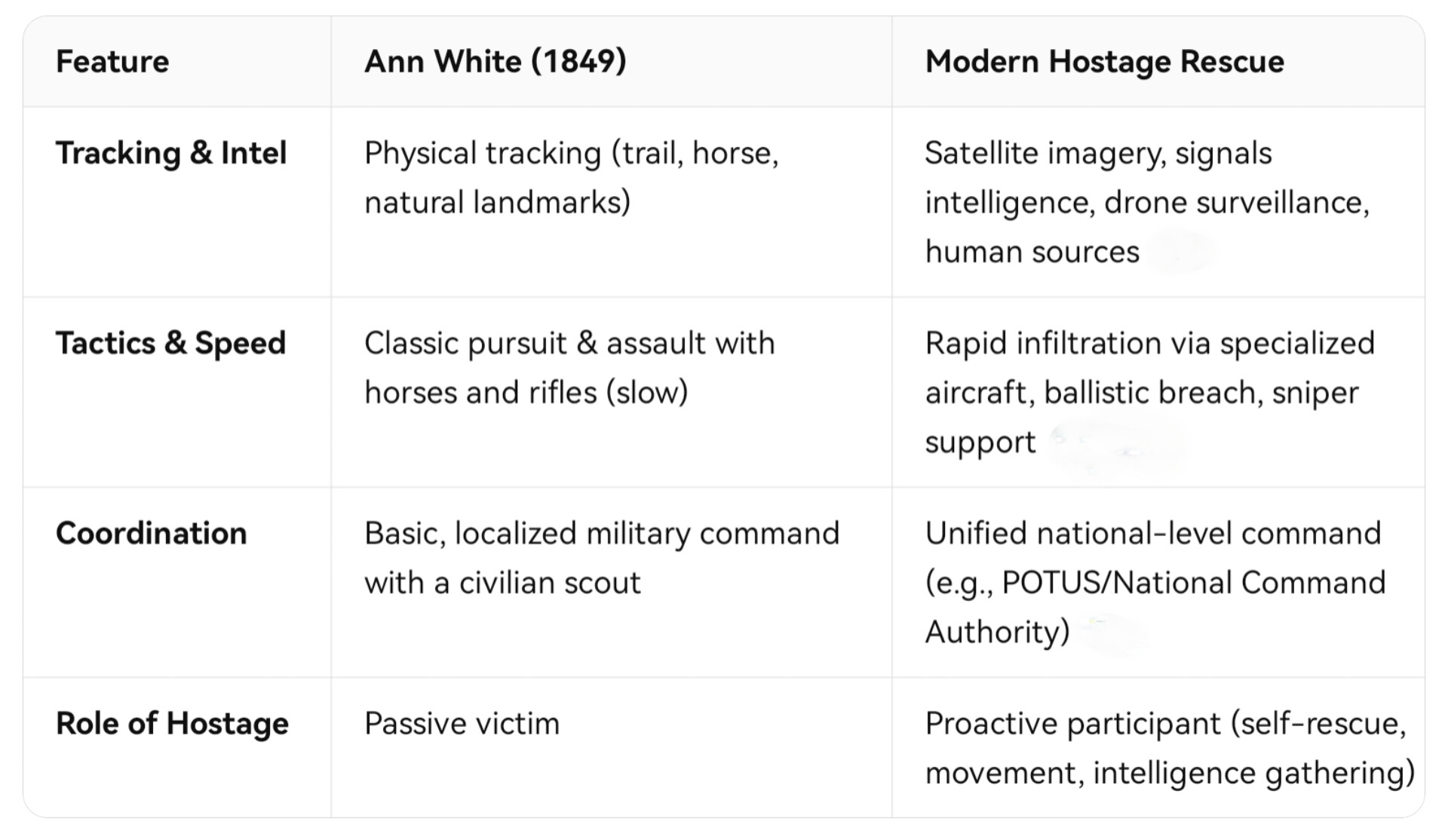
Tactics have also been transformed. Modern rescue teams do not charge a camp on horseback. They parachute from high‑altitude aircraft, fast‑rope from helicopters, or approach silently on foot using night‑vision goggles and suppressed weapons. They rehearse the mission on full‑scale mock‑ups of the target building, sometimes for weeks. Snipers are positioned to eliminate sentries without alerting the rest of the enemy. Breachers use explosives or ballistic rams to create sudden entry points, and team members clear rooms in coordinated, near‑robotic choreography. The entire assault often lasts less than five minutes.
Command and control have changed just as dramatically. In 1849, a local army officer and a civilian scout made tactical decisions on the fly. Today, a hostage rescue falls under national command authorities—often requiring presidential approval. The White House Situation Room, the National Security Council, and the military’s Joint Special Operations Command all become involved. Legal and diplomatic considerations are weighed: Will the rescue violate another nation’s sovereignty? What if hostages are killed by friendly fire? The decision to go is never taken lightly; armed rescue is officially the last resort, used only when there is “credible intelligence” that the hostage’s life is in imminent danger.
The Role of the Hostage and the Weight of Hope
One of the most telling differences is the role of the hostage. Ann White was entirely passive. She could not signal her location, influence her captors, or contribute to her own rescue. She could only endure and, tragically, hope. That hope was amplified by a dime novel that promised a fictional rescue—a promise the real world could not keep.
In contrast, modern hostages are often taught survival and resistance techniques. Some have managed to escape on their own, like a young girl in India who bit through her bindings and ran to a neighbor’s house. Others use hidden cell phones to send location data to authorities. During the 1970s Iranian hostage crisis, American diplomats moved secretly from house to house, actively evading capture. The modern hostage is no longer a mere victim; when possible, they become a source of intelligence and even an agent of their own liberation.
Yet the psychological burden remains. Captives in the twenty‑first century still hope for rescue, and that hope can be a lifeline or a torment. American POWs in Vietnam tapped a secret code on walls to maintain morale and a sense of community. Hostages of ISIS clung to news of U.S. special forces operations. Hope is as powerful a weapon as any carbine—and as fragile.
Where the Eras Converge
For all the technological and tactical advances, the fundamental dilemma of hostage rescue has not changed. Every rescue is a race against an invisible clock. The captors may kill the hostage at any moment—out of spite, fear, or because a rescue team’s approach is detected. In 1849, Ann White died by an arrow in the chaos of the assault. In 2014, during a failed rescue of American journalist James Foley, ISIS moved the captives just before U.S. commandos arrived. The pattern is timeless: a rescue that arrives seconds too late is a failure, no matter how sophisticated the equipment.
Another constant is the moral weight carried by the rescuers. Kit Carson buried a woman whose last conscious thought might have been that he would save her. Modern special operators live with similar ghosts—the hostage they found dead, the mistake that cost a life, or the impossible choice between assaulting and waiting. The difference is that today’s soldiers have psychological support, after‑action reviews, and a professional culture that acknowledges moral injury. Carson had whiskey and silence.
Conclusion: Two Sides of the Same Tragic Coin
The story of Kit Carson and Ann White is not merely a dusty frontier anecdote. It is a warning that no amount of heroism or tracking skill can guarantee a happy ending. Modern hostage rescue has reduced—but not eliminated—the role of luck. Intelligence has replaced instinct. Night‑vision goggles have replaced moonlight. But the central fact remains: a hostage rescue is a high‑stakes gamble in which the hostage’s life is the currency. Ann White’s body, still warm in the New Mexico dirt, and a modern team discovering an empty room after a tip went cold are two versions of the same tragedy. The technology has changed; the human heart has not.
Books on Amazon
Counter Insurgency Operations For Government Agencies
A Tactical Guide For Low Intensity Warfare
This book is written with the aim to give the reader the knowledge to be able to formulate and execute counter insurgency operations with minimal equipment and logistical support.
Kindle @ https://www.amazon.com/dp/B0D61H5RLK
Paper Back @ https://www.amazon.com/dp/B0D63XZS1V
Hard Cover @ https://www.amazon.com/dp/B0FLWHL9R6

