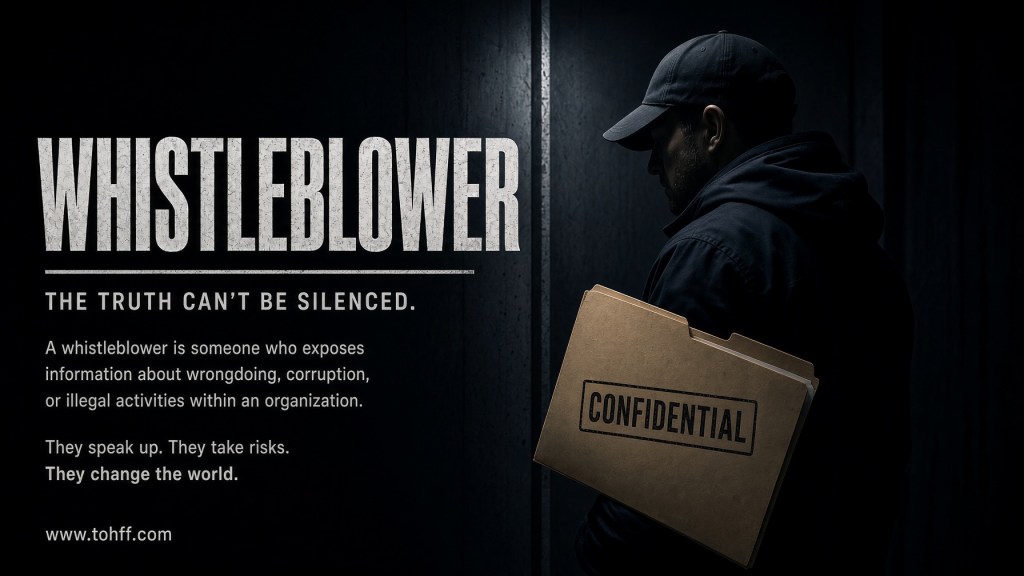
It can be very confusing for the whistleblower and honest person, who when reporting a wrongdoing or a crime, is dismissed, or they themselves are accused of making up stories and being problematic. This happens a lot more than people think.
You would think in today’s world where corporations, NGOs and government agencies talk endlessly about human rights, equality, and fairness, that the concerned citizen with evidence of fraud, corruption or crimes would be welcomed to present their evidence, but the reality in most cases is the extreme opposite.
Over the years I have worked with numerous clients and on cases where there was clear evidence of wrongdoing, but the systems responsible for acknowledging and rectifying these problems were dismissive or just plain hostile towards the complainant or victim.
Honest people, who seek to report wrongdoings and crimes, firstly have to accept that they will not, by many, be seen as doing the right thing. They will be seen as a snitch, a back stabber, an informant, a trouble maker, and a whistleblower. By many, they will be seen as the one who is rocking the boat, causing unnecessary problems for others, who just want a quiet life. They will be ostracized as others will fear they could face intimidation, damage their careers, or lose their jobs just by associating with them.
For the honest person who is just seeking to do the right thing, they need to understand that corporate and governmental structures are not really interested in what’s right and wrong and are guided by outside influences. There are the issues of institutional ego, saving face and reputational damage. Usually, these issues take precedence over the actual wrongdoing and crime that is being reported. After a whistleblower has found themselves being labeled as being problematic, this can really be confusing, to say the least.
Here I am going to talk about some of the issues I have encountered over the years where what initially appeared to be straight forward right and wrong investigations cases became complicated because people wanted to save face, save money or just dismiss the case due to outside influence.
Small Town USA & Assisted Suicide
Many years ago I worked with an elderly client who’s son, who had a history of drug abuse, died suddenly in a small US town. All indications were it was assisted suicide. To start with, a signed will, for one of the “Care Givers”, which left them virtually all of the deceased’s property, was found next to the body.
An issue was there had never been an autopsy performed on the body before burial, which is standard procedure in most cases where someone died alone. The police stated they had talked with the deceased’s doctor, who no one close to the deceased had heard of… The deceased had been getting prescription medications from multiple “Pain Clinics” and doctors… The doctor who was called, obviously didn’t want an autopsy done, due to them issuing questionable prescriptions. The local cops just wanted the minimal paperwork and the case was closed.
This, as with the other case examples here, are long and complicated, but I will summarize. To prevent further investigation by the family, the cops reopened the case, but we’re not investigating it… Multiple meetings had taken place, evidence of wrongdoing was presented. And all agreed there should have been an autopsy to start with but, the cops were waiting for new leads.
This small town police department would have been responsible for exhuming the body for the autopsy, but that costs a lot of money. Also, they would have to admit they had made mistakes, which would make them liable for damages. For the family to file a law suit against the police department would cost a lot of money. Finding local lawyers who wanted to take a case against the police would be difficult. And, the chances were the local lawyers, hired by the client, and judges would be working for the interests of the local police.
A lot to do with this case was not about right and wrong, it was about saving face and money for this small town police department. As for the deceased, who cared? The grieving family, sure, but legal battles take time and money. Money they had, but time was something the elderly father didn’t have, and the other members of the family wanted his money. A sad situation? No, just reality…
Belgium & A Medical Insurance Claim
Belgium, like most European countries, likes to portray itself as a front runner in human rights and diversity. This might sound cool, but the realities are when you deal with the system there, you will find it, as shady and questionable as those places the European Union likes to point it’s finger at for being corrupt and mismanaged.
The case I was asked to help with involved a lady, a former small business owner, who had been involved in a very bad car accident, literally hit by a truck. Initially written off for dead, she survived, but suffered a severe brain injury and other physical disabilities.
I was asked by a former student of mine if I could help with this case because the lady was being harassed by unknown individuals, and everyone thought she was just being paranoid. My former student who had known her before the accident, thought there was more to it, and he was right.
A major problem for this lady was her disability and brain injuries. She had anger issues, and rightfully so, she had lost everything. One minute a healthy business woman, the next a cripple, with brain damage, living on social benefits, due to no fault of her own.
Another long story made short… There was evidence she was under surveillance from private investigators. I take it they were tasked by the insurance company who was liable for the claim she had for the accident.
I witnessed that she was subjected to unnecessary, and painful, medical tests by a doctor assigned for insurance claims purposes. The lady’s doctor objected to the tests. The doctor doing the tests said they were unnecessary, but the assigned doctor for the insurance claim insisted. This same doctor tried to cancel tests that were requested by the lady’s doctors… A very messed up situation.
Evidence was reported to the police and others, and what happened? Not, a lot… After 8-years things are still ongoing.
As I said, a major issue was the lady’s disability, mental health, and anger issues. Combined this with the lack of a support group, her parents were elderly, and she was used to being independent. This meant her communicating her problems and concerns was very difficult. So, many people did not take her seriously, as she was just a crazy woman to them.
Society is conditioned to respect doctors and lawyers, not crazy disabled women. So, it was easy for the doctors and lawyers dealing with the insurance claim to discredit her and get any complaints dismissed. These doctors and lawyers main interest was not this lady’s well-being, but it was to minimize any insurance pay out, and preferably to cancel her claim.
If this lady had money to hire decent lawyers, and had an effective support system from the start, I am sure things would have been different. But, she didn’t.
London/Moscow & Counterfeit Pharmaceuticals
Back in the day I was approached multiple times by associates who had evidence of fraud or crimes being committed against large international corporations in the former Soviet Union etc. The information had come to them from various sources, and they asked me to approach these corporations with the information, the tip-off was free, and it they wanted our help to solve the problem then we could talk business. No strings attached, we were trying to help and maybe make some money.
In one case there was evidence of pharmaceuticals from a large London based company being counterfeited on a large and sophisticated scale and sold in Moscow etc. Samples were acquired on request of the London company and delivered. Apparently, these were the best fakes they had ever seen.
A British investigator traveled from London to Moscow. And, this is where things got confusing… I am sure this British investigator ticked all the boxes in London, belonged to the right gentleman’s clubs, and was a respected free mason etc… The usual qualifications. But, there was friction in Moscow. He seemed to have the ingrained British establishment dislike of Russians, the typical British superiority complex, which was not really a fit for business in Russia.
He saw the evidence, was taken to the counterfeit medication sales locations, etc. It was explained that for any investigation and enforcement to go forwards the London pharmaceutical company would need to lodge a complain and cooperate with the investigators etc. All basics he would have known. But, he seemed to have been sent to Moscow for a damage limitation assessment, rather than to solve the problem.
His assessment was that the enforcement would have been too complicated and the local contacts and police were not trustworthy. Which, at the time was confusing for my associates and myself… As, things could have been quickly rolled up when the button was pushed.
But, the main concern for the pharmaceutical company was not the potentially poisoned drugs, or drugs with no active ingredients being sold on shop shelves with their brand name on them. But it seemed to be who would find out about the problem and would it effect their reputation.
This was a large sophisticated criminal counterfeit operation. This London based pharmaceutical company’s main worry was if they took action, admitted there was a problem, and shareholders and the media found out then it could effect its sales and share prices. So, better off just to look the other way, deny any knowledge, claim innocence, and deal with any law suits when they appeared. This was reportedly the decision of it’s corporate security management team. So, very much a case of hear no evil, see no evil and speak no evil…
Corporate Security: Reputation Management is Security Management
From a security management perspective, your clients reputation needs to be considered in all threat assessments, and it needs to be protected. From the other side of the table, this can be a huge obstacle for the whistleblower, concerned citizen or private investigator trying to present evidence of wrongdoing and get the problems solved.
As you have seen with the case of the pharmaceutical company, the main interest of the company’s security management team was the reputation of the company. Things like what was morally right and wrong had nothing to do with any decision making.
I have approach numerous companies with identified problems over the years and usually the smaller companies who were developing were the most receptive. The large corporations were usually dismissive. And I put this down to several factors.
Most security management positions in large corporations are box ticking jobs, retirement jobs for former senior police or military personnel. For security management jobs with the larger corporations having gone to the right schools, also being members of the right social or golf clubs and mason’s lodges helps. So, those people in those types of positions generally don’t like to work… They don’t like it when problems they can’t take credit for identifying end up being dumped on their desks to solve. It’s far easier for them to discredit any accusations and the whistleblower, than have to deal with them.
These people are the security management for the corporation, so who will the corporations senior management and shareholders listen to? These people are employed by the corporation. These people are vetted. These people are known. So, these people’s opinions far out weigh the voice of a whistleblower.
In most cases it’s the security management teams job to dissuade the whistleblower from pursuing their claims, to identify and squash any evidence, and if required intimidate the whistleblower with threats of legal action etc.
The disabled lady in Belgium that I mentioned earlier, was actually being followed by private investigators, there had been a tracking device on her car, she had been overtly photographed, her bins had been gone through… Was this the legitimate activities of private investigators working on an insurance claim or intimidation? I will say that these were the activities of dumb private Investigators playing gangster with a disabled woman who they couldn’t scare…
To discredit the whistleblower or concerned citizen their reputation will likely be targeted. They can expect to be demoted or will be fired from their job for bogus reasons. When fired, separation benefits can be withheld or employment paperwork can be lost to complicate social benefit claims and cause gaps in work history. The police can be involved when the whistleblower is reported for stalking, or trying to blackmail those they are seeking to report. The game card for countering whistleblowers is endless and can get extremely dirty.
With social media the whistleblower can expect for their accounts to be targeted with fake accusations, abuse, hacked, and closed for mysterious reasons. Social media security is essential because not only will the whistleblower be targeted but also their friends and family. It’s not uncommon for partners, families and associates of the whistleblower to receive messages or phone calls from unknown people with fake stories and accusations of the whistleblowers criminal or sexual activities.
For those seeking to tell the truth, understand there will be many people that don’t want the truth known. These people will target you. If you have skeletons in your closet, that would be better left there, then it might be best for you to keep your mouth shut. Personally, I tend to recommend letting any skeletons out of the closet, and then introducing them to people. Such tactics takes away the plastic gangsters initiative, and tends to make them uncomfortable.
The Police: The Often Reluctant & Necessary Friend
Dealing with the police can be very tricky. Like corporate security personnel most cops don’t want extra work loads. Cops are paid a salary, so are paid if they help you or not. Very few are paid by results, and where they are, they will focus on the easy to solve cases due to quicker turn around times.
Complexed non-violent cases tend to stay at the bottom of the pile, unless there is outside influence. This is why a lot of corporate security jobs go to senior ex-cops, as they know people who can get cases taken seriously.
When you take a complaint to the police it needs to be presented properly, and don’t be surprised if you are still dismissed. Before approaching the police look into what they can actually do to help. Is the case your presenting actually criminal? Are you going to the right department? If your reporting police corruption or negligence expect hostility. Plan and frame the complaint properly, and don’t expect the cops to be very enthusiastic about talking to you.
If you get your story across properly and are take seriously things can go two ways. 1. The cops will be very supportive and helpful 2. They will work against you.
From a private investigators perspective I have dealt with some excellent cops, and some completely arrogant assholes. Many cops seem to have a superiority complex, usually due to the fact they spend most of their time dealing with criminal assholes and bullshit. Their outlook on life can be jaded. This is where you need to present yourself properly and professionally.
Many people are surprised when they go to file a complaint with the police and nothing happens. In many places these days the police forces don’t have the manpower or budgets to deal effectively with all the complaints and cases they have to deal with. This is where you must realistically understand how the police can actually help you. It’s a sad fact that many people put their hopes and trust in the police helping them, only to get nothing in return.
For many, what I said earlier about the police working against you would have sounded strange. Aren’t the police there to help you, arrest criminals, and enforce the law? Even though many cops can think they are superior to the rest of us, and have special powers, they are still human and are influenced by many factors.
How the police operate in many places these days is largely politically influenced. This you must understand if you’re a whistleblower as you can quickly end up being arrested yourself, for saying what you believe is right. Let’s look at the Grooming Gang scandals in the United Kingdom, where the police turned a blind eye to the systemic sexual abuse of vulnerable young girls by immigrant gangs.
The failure of the UK police to act on grooming gangs in places like Rotherham, was the result of a organisational failure driven by a complex mix of fear of appearing racist, misplaced political correctness, and a culture that dismissed victims. An estimated 1,400 children were sexually exploited between 1997 and 2013, in this one town, and the authorities repeatedly ignored credible warnings.
The police knew the child abuse was happening, but ignored it, and covered it up, for political reasons. Police officers failed to take victims and intelligence seriously. Whistleblowers who provided names, addresses, and car registrations of suspects were belittled, with officers saying it wasn’t “real intelligence”. Victims were often regarded “with contempt,” and the abuse was dismissed as a “lifestyle choice,” with some officers referring to the girls as “Little Sluts”. This culture of disbelief meant that crucial information was not acted upon, allowing perpetrators to remain at large.
The Rotherham Council and South Yorkshire Police demonstrated “resolute denial” and resistance to addressing the problem for years. When the scandal was exposed, the council even sought an injunction to prevent reporting, and police launched a criminal inquiry into the journalist who broke the story, rather than the abusers. Subsequent investigations found “serious failings of policing” and a “systemic organisational failure,” but no senior officer was held accountable, with the Independent Office for Police Conduct (IOPC) stating it could not identify a named individual responsible.
Grooming gangs are still operating and targeting vulnerable young girls in the United Kingdom, with alleged police cover ups taking place in many areas including London. Political influence on policing is a very real problem that must be considered by any whistleblower.
Cops not wanting to work, and then cops working to protect their fellow officers, their forces, and politicians, from criminal charges and civil law suits, need to be considered before any whistleblower complaints are filed.
Then there is blatant and traditional police corruption. When a complaint is filed strange things can happen before charges are made or when the case is presented in court. To start with leads are not followed up on, evidence ignored, witnesses not questioned, suspects not pursued, everything gets delayed, statements and evidence goes missing… But, why would a cop risk their job to do such things? Because they can… Who will question them, they are the police? Also because it could be in their interests financially or politically.
It’s not unheard of when a criminal report is filed, for the cops to go and try to cut a deal with the suspects, to help them get the case dismissed. Business is business and cops are only human.
I have been dealing with a terrorism case where the main suspects mobile phones were never opened or analyzed… A court order was never issued for the suspect to open the phones. The presented reason, there was enough evidence already for the case to proceed. These days why would the police not want to open a terrorists phones? Why would they not want to know who he was messaging and talking to? Why would they not want to identify his contacts and network? The only reason is, because they are protecting his network…
But, they are the police… And who will question them? As I said previously, I tend to recommend letting any skeletons out of the closet and then introducing them to people… Especially other people’s skeletons…
Books on Amazon
Investigative Journalist Security: Staying Alive to Tell the Truth
Sadly, these days the rights of journalists, activists, bloggers and those who believe in freedom of speech in general, are being eroded, usually in the name of national security or political correctness. This book is a security guide for journalists, bloggers and activists!
Audio Book @ https://www.amazon.com/dp/B0FG19DL8Q
Kindle @ https://www.amazon.com/dp/B07R968TP8
Paper Back @ https://www.amazon.com/dp/1096324997
Hard Cover @ https://www.amazon.com/dp/B0FKSFPBGR

