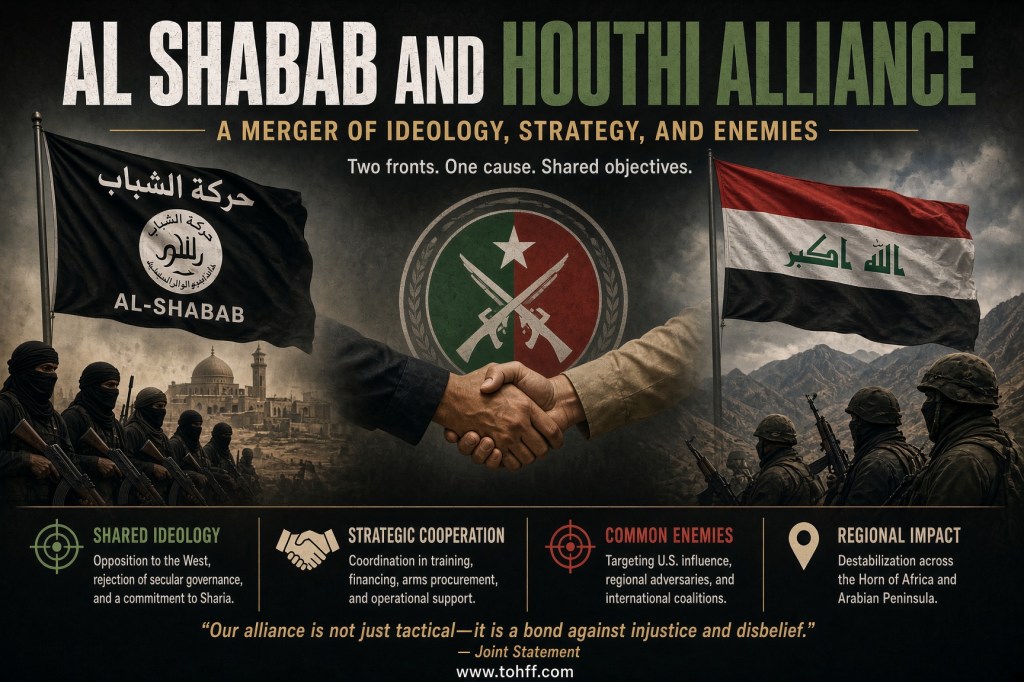
A strategic partnership of convenience has emerged between Somalia’s Al-Shabaab and Yemen’s Houthi movement, two groups that belong to historically opposing religious traditions but have found common cause in their shared hostility toward the United States and Israel. According to investigations by The Wall Street Journal and corroborating reports from Somali, US, and Yemeni officials, this cooperation has been developing since at least 2023 and now spans arms trafficking, military training, drone technology, and potentially direct battlefield coordination. This partnership is unfolding against the backdrop of a dramatically escalating conflict between the Houthis and Saudi Arabia, which has fundamentally reshaped the strategic environment of the Red Sea and Gulf of Aden.
The relationship is mutually beneficial. Al-Shabaab, al-Qaeda’s largest and most lucrative affiliate, possesses significant financial resources, estimated at over $100 million annually from extortion and other activities, but lacks sophisticated weaponry. The Houthis, backed by Iran, have advanced military technology including missiles and drones but require cash and a strategic foothold on the African side of the Gulf of Aden.
The Houthi-Saudi War: A New Strategic Context
The Houthi-Saudi conflict has dramatically intensified in recent months, with the Houthis launching repeated drone and missile strikes on Saudi cities and oil infrastructure, while Saudi warplanes have pounded Houthi positions across Yemen. The Houthis have fired repeatedly into Saudi Arabia over the past week, causing alarms over cities in the south and west. Houthi military spokesman Yahya Saree said the group had launched fresh drone and missile strikes on the major Saudi Red Sea oil port of Yanbu, and at a southern Saudi airbase at Khamis Mushait.
The economic consequences have been severe. Houthi strikes on a Saudi pipeline have disrupted up to 4 percent of global oil shipments, further exacerbating the supply shortage triggered by the Iran war. The price of Brent crude hovered around $108 a barrel, close to its highest levels since May, and the politically sensitive average retail price of diesel fuel in the United States hit another all-time high above $6.30 a gallon for the first time.
The conflict has also extended to the maritime domain. The Houthis have swept through Yemeni towns along the Red Sea coast and seized islands in the Bab el-Mandeb Strait at its mouth, releasing battlefield video of fighters seizing armored vehicles from Saudi-backed forces. In July 2026, the Houthis announced a blockade of Saudi Arabia’s shipping, and in August 2026, fifteen countries established a Multinational Maritime Defence Coalition led by Saudi Arabia to protect shipping in the Bab el-Mandeb Strait, the Red Sea, and the Gulf of Aden.
Saudi Arabia has reportedly offered a two-week ceasefire to the Houthis through Oman, though the Houthis have demanded a final and comprehensive solution to end the conflicts. The pro-Houthi Lebanese media outlet Al-Mayadeen reported that Saudi Arabia has also sought assistance from China, its largest trading partner with Iran.
Origins and Drivers of the Cooperation
The partnership emerged despite deep sectarian divisions between the Sunni Al-Shabaab and the Shia-aligned Houthis. US, Somali, and Yemeni officials have consistently described the relationship as a “partnership of convenience” driven by shared adversaries rather than ideological affinity. Al-Shabaab opened communications with the Houthis in 2024, seeking help in acquiring anti-aircraft weapons, drones, and shoulder-fired rockets to counter aerial attacks, including from the United States.
The strategic logic is clear: Yemen and Somalia sit on opposite sides of the Gulf of Aden, which connects the Indian Ocean with the Red Sea. Before the Iran war, approximately 12% of the world’s seaborne oil passed through this waterway. With the Strait of Hormuz facing disruption, the Gulf of Aden has become even more critical for global oil shipments, making the Houthi-Al-Shabaab partnership a direct threat to international maritime trade. The current Houthi-Saudi war has only heightened the strategic value of this cross-Gulf partnership.
Key Intermediaries and Arms Trafficking
A central figure in building this relationship was Jibril “One-Armed” Yahya Ali, a Somali national who served as the primary liaison between Al-Shabaab and the Houthis from at least 2023. The Houthis provided him with a furnished apartment in Sanaa and a Yemeni passport issued under an assumed name. An internal assessment by Yemen’s Counter-Terrorism Service described Jibril as a key figure in strengthening relations between the groups, particularly in transferring weapons, military equipment, and technical expertise. He was killed on February 12, 2026, in a missile strike near Al-Ghaydah in eastern Yemen. A second key operative, Sheikh Ahmed Elmi Samatar, was sent to Yemen in 2024 as a more senior envoy, presenting Houthi officials with a detailed weapons wish list that included shoulder-fired anti-aircraft missiles, Katyusha rockets, sniper rifles, attack drones, anti-tank missiles, and night-vision equipment.
The weapons trade forms the backbone of the cooperation. Front companies allegedly disguise shipments as civilian goods before moving them through Yemeni ports such as Mukalla. Fishing vessels and speedboats then carry the shipments across the Gulf of Aden to poorly monitored stretches of Somalia’s northern coastline. In April 2025, US forces destroyed two unflagged vessels traveling from Yemen toward Somali waters, which US Africa Command said were carrying advanced conventional weapons.
Military Training and Drone Technology
Military training has become a significant component of the partnership. US and regional security officials report that more than 100 Al-Shabaab fighters have traveled to Yemen for instruction, including drone operations, advanced weapons, and explosives techniques. One group reportedly spent three months in Yemen’s Sa’dah region, the Houthis’ main stronghold, training in drone assembly and the use of control and direct-vision systems. Houthi instructors have also traveled to Somalia to train Al-Shabaab militants. In June 2026, a four-member Houthi delegation crossed from Yemen by boat and traveled to Jilib, Al-Shabaab’s main stronghold in southern Somalia, for discussions involving weapons, training, and wider cooperation.
Strategic Implications and Global Concerns
The Al-Shabaab–Houthi partnership has drawn serious concern from US military leadership. Gen. Dagvin Anderson, commander of US forces in Africa, warned that the relationship has “global implications” beyond the immediate region. He noted that Al-Shabaab, “al-Qaeda’s largest and most lucrative affiliate,” is gaining access to more sophisticated weapons and training while the Houthis are extending their geographic reach and “gaining a foothold that could further destabilize one of the world’s most critical economic chokepoints”.
Of particular concern is the reported plan for the Houthis to deploy radar systems in Al-Shabaab-controlled territory to monitor maritime traffic along the Somali coast. Such systems could potentially allow the groups to monitor the movement of commercial and military vessels operating in the Gulf of Aden and approaches to the Red Sea. This represents a shift from episodic attacks launched from Yemen toward a cross-Gulf network capable of finding, watching, and eventually threatening ships from both shores of the Gulf of Aden. The current Houthi-Saudi war, with its maritime blockade and attacks on shipping, makes this cross-Gulf capability even more strategically significant.
The situation is further complicated by Israel’s growing presence in Somaliland. In December 2025, Israel recognized the independence of the region, which includes the port of Berbera, a strategic position for controlling the Red Sea and countering the Houthis. The Houthis have threatened to target any Israeli activities in Somaliland, and a Houthi delegation reportedly traveled to southern Somalia in June to discuss coordination with Al-Shabaab leaders against Israel’s presence in Berbera, offering additional weapons and training in exchange.
The Al-Shabaab–Houthi relationship has evolved from transactional arms dealing into a multifaceted strategic alliance involving training, logistics, and potentially joint operations. The current Houthi-Saudi war has added a new and dangerous dimension to this partnership, as the Houthis demonstrate their capacity to disrupt global energy supplies and challenge regional powers, while simultaneously building cross-Gulf networks with Al-Shabaab. Despite the killing of key intermediary Jibril Yahya Ali in February 2026, Al-Shabaab quickly appointed a replacement, indicating the channel remains active. The partnership threatens to transform a previously opportunistic collaboration into a regional and global security challenge, capable of disrupting one of the world’s most important maritime and oil trade routes. As Gen. Anderson warned, this is not merely a regional problem, it is a threat with global implications.
Orlando “Andy” Wilson
Obsidian Research Bureau
Books on Amazon
Counter Insurgency Operations For Government Agencies
A Tactical Guide For Low Intensity Warfare
With the opening of many countries borders, the de-funding of police and the indifference of criminal and court systems to imprisoning career criminals and gang members, there is the huge potential for the
destabilization of states and cities by organized crime and terrorist groups.
Kindle @ https://www.amazon.com/dp/B0D61H5RLK
Paper Back @ https://www.amazon.com/dp/B0D63XZS1V
Hard Cover @ https://www.amazon.com/dp/B0FLWHL9R6

