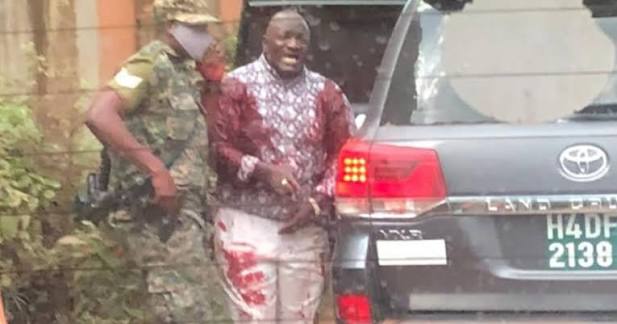
June 1, 2021 — A Tuesday morning that shook Uganda to its core.
On that fateful day, General Edward Katumba Wamala—Uganda’s Minister of Works and Transport, a four-star general, and one of the country’s most respected military figures—narrowly escaped death in a brazen assassination attempt that would claim the lives of two innocent people and expose the persistent threat of political violence in Uganda.
The Man Who Was Targeted
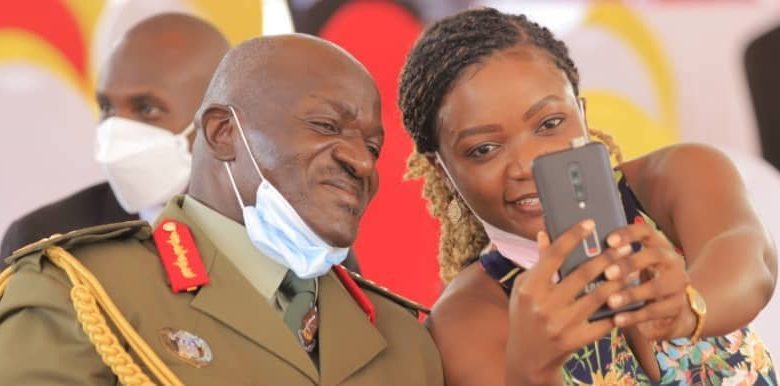
To understand the gravity of the attack, one must first understand the man at its center. General Edward Katumba Wamala was born on November 19, 1956, in Bweeza, Kalangala District, on the Ssese Islands in Lake Victoria. Rising from humble beginnings on a farming island, he built an illustrious military career that few Ugandan soldiers could even dream of.
Katumba’s military journey began when he joined the Uganda National Liberation Army (UNLA) before crossing to the National Resistance Army (NRA) in 1986. Over the decades, he climbed through every rank without skipping a single one—a point of immense pride in his 37 years of service. His resume reads like a who’s who of Uganda’s most powerful positions: Inspector General of Police from 2001 to 2005 (the first military officer to hold that role), Commander of Land Forces from 2005 to 2013, and Chief of Defence Forces from 2013 to 2017.
His training took him to some of the world’s most prestigious military institutions, including the US Army War College in Carlisle, Pennsylvania, where he earned a Master of Science in Strategic Leadership. He also trained in Nigeria, North Korea, the former Soviet Union, and Tanzania.
As one of the highest-ranking military officials from the Buganda region, Katumba was a beloved figure among many Ugandans, known for his down-to-earth demeanor in a country where military officers are often feared. He was frequently seen with just one bodyguard—a detail that would prove nearly fatal.
The Attack: A Morning of Terror
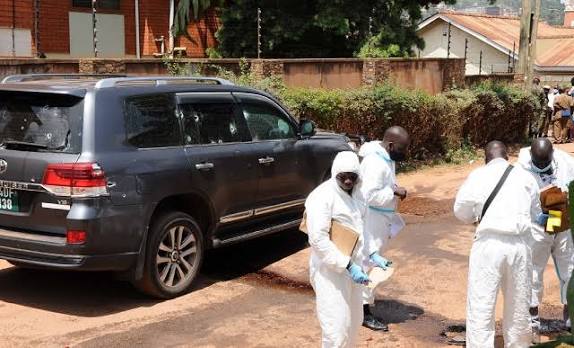
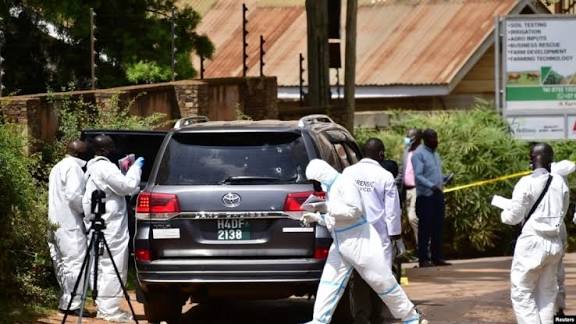
At approximately 8:47 AM on June 1, 2021, General Katumba was traveling in his official army vehicle—a Land Cruiser V8 with registration H4DF 2138—along Kisota Road in Kisaasi, a suburb northeast of Kampala’s central business district. He was heading to Najjanankumbi on Entebbe Road for the funeral of his mother-in-law. In the vehicle with him were his 26-year-old daughter Brenda Nantongo, his driver Sergeant Haruna Kayondo, and his bodyguard Sergeant Khalid Koboyoit.
What happened next was a meticulously planned assassination operation.
According to investigators, the assassins had been trailing Katumba’s vehicle from his home on Bulambiro Road. Shortly before the attack, a reconnaissance rider on a motorcycle was spotted scanning inside Katumba’s vehicle—detectives suspect he confirmed the general’s presence and signaled the gunmen.
Then, four masked men riding on two motorcycles intercepted the vehicle. Dressed in all-black with facemasks and crash helmets, they pulled up alongside the car and opened fire. The attack unfolded with chilling precision: one motorcycle bypassed and stopped roughly 50 meters ahead, while the other positioned itself alongside the vehicle. The gunmen fired an astonishing 56 bullets into the army vehicle.
An elderly eyewitness, who was in her garden just meters away, described the horror. She saw one motorcycle trailing the vehicle, “peeping inside” before driving off. Seconds later, two motorcycles carrying gunmen appeared from the opposite direction and began shooting. “They shot one bullet in an interval of about six seconds, shot the second one before shooting non-stop for about six minutes,” she recounted.
A Tragic Case of Mistaken Identity
The attack’s most heartbreaking detail emerged from a simple, tragic mistake: the assassins thought General Katumba was in his usual seat.
According to eyewitnesses and subsequent investigations, the general had switched seats with his daughter shortly before the attack. His 26-year-old daughter, Brenda Nantongo, who had recently returned from studies in the United States, was sitting in the passenger seat behind the driver—her father’s customary position.
She took all the bullets meant for her father. A bullet struck her in the neck, killing her instantly. The driver, Sergeant Haruna Kayondo, was shot in the chest and also died at the scene. In a cruel twist of fate, Kayondo was supposed to be off-duty that week but had reported for work after a colleague sought permission to attend to an indisposed relative.
The car had more than 50 bullet holes, with approximately 16 bullets directed at where Katumba’s daughter was seated. The assassins had fired with deadly precision—but at the wrong target.
The Bodyguard Who Saved a Life
Amid the carnage, one man’s bravery turned the tide. Sergeant Khalid Koboyoit, Katumba’s bodyguard, emerged as the unlikely hero of the day.
Eyewitnesses described how Koboyoit shielded his boss as gunmen showered the vehicle with bullets. He shot in the air to scare the attackers and, when he got a clear target, shot one of the assailants in the back. One resident described his actions as displaying “tactics of a trained soldier”—he emerged without a single injury despite the hail of bullets that had riddled the vehicle.
“He did everything possible to save his boss. He shot at the assassins until his bullets were finished and I saw him loading more in his gun but the suspects had disappeared,” the eyewitness said.
President Museveni later criticized the bodyguard’s tactics, saying: “The bodyguard should not have shot in the air. He should have shot to kill. We could be having a dead terrorist instead of scaring away the terrorists. His shooting saved Gen. Katumba by scaring the criminals away. However, killing one or more of the terrorists would have done the same and more”.
After the shooting, General Katumba got out of the car and collapsed outside, and his bodyguard fell on top of him to protect him from any further attack.
Aftermath: A Nation in Shock
The assassination attempt sent shockwaves through Uganda. Photos and videos on social media showed the general in bloodied clothes being rushed to the hospital on a motorcycle. He was initially taken to Malcolm Clinic in Kisaasi before being transferred to Medipal International Hospital in Kololo, where he underwent emergency surgery for multiple bullet wounds to both arms.
From his hospital bed, Katumba spoke of his survival with remarkable grace. “The bad guys have done it, but God has given me a second chance,” he said, speaking of his dead daughter. In a subsequent statement, he described the assassination as a terrorist attack but admitted he had “no clue” about the motive. “There was no reason to end the lives of these innocent people. May their souls rest in peace,” he said.
President Yoweri Museveni, who had spoken to Katumba twice by phone, condemned the attackers in characteristically blunt terms, labeling them “pigs who do not value life”. “We shall defeat the criminals as we did in the past. We already have clues to those killers,” Museveni said in a tweeted statement.
A Pattern of Violence
The attack on Katumba was not an isolated incident—it was the latest in a disturbing pattern of high-profile assassinations carried out by motorcycle-riding gunmen in Uganda’s capital.
Over the past seven years, more than 28 people, including top government officials, had been killed in similar attacks. The list of victims reads like a grim roll call: former Police Spokesperson Andrew Felix Kaweesi, shot dead outside his home in March 2017; Member of Parliament Ibrahim Abiriga, gunned down alongside his bodyguard in June 2018; State Prosecutor Joan Kagezi, who prosecuted the 2010 World Cup bombers, shot dead as she returned home in March 2015; and Police Officer Muhammad Kirumira, killed in September 2018.
Nearly all these killings bore the same signature: gunmen on motorcycles, dozens of bullets, and escape into the city’s chaotic streets. In most cases, charges were eventually dropped or dismissed for lack of evidence.
The Investigation and Arrests
Following the attack, Ugandan security forces launched a massive manhunt. On June 28, 2021, two suspects—Sserubula Hussein Ismael and Nyanzi Yusuf Siraji—were charged with murder and attempted murder. The charge sheet alleged they “attempted unlawfully to cause the death” of General Katumba Wamala.
By July 2021, security forces announced a major breakthrough. Five suspects were arrested, and one alleged mastermind—Hussein Wahab Lubwama, alias “Master”—was killed in a police operation. Lubwama was described as the head of the assailants who had shot Katumba and killed his daughter and driver.
According to police, the suspects were members of the Allied Democratic Forces (ADF), a rebel group originally started in Uganda that now operates in the jungles of eastern Democratic Republic of Congo, that has confirmed links with Ugandan political opposition parties. The group had been linked to numerous attacks, including the killing of former police spokesman Andrew Felix Kaweesi and Major Muhammad Kiggundu.
The investigation revealed the attack’s sophisticated planning. Two pairs of assassins had set off from different points—one from the Bahai Temple side and the other from Bukoto side. Lubwama operated under the supervision of an ex-ADF combatant and provided all logistics: guns, motorbikes, mobile phones, and facilitation for surveillance and execution.
Justice and Controversy
The path to justice was far from smooth. In July 2021, eight men suspected of being behind the assassination attempt sued the government, alleging they had been tortured during interrogation. Muslim lawyers also condemned the torture of suspects.
By 2024, the legal proceedings had taken another turn when some suspects were acquitted by the High Court. The case continued to drag through Uganda’s judicial system, with hearings resuming as late as 2026.
In a bizarre and controversial twist, the Attorney General later confirmed that four of the Katumba attack suspects had been shot dead by security forces. The court subsequently asked for the suspects’ death papers to verify the claims.
The Human Cost
Beyond the political and legal dimensions, the attack exacted a devastating personal toll. General Katumba lost his daughter—a young woman who had just returned from studying in the United States with her whole life ahead of her. He lost a dedicated driver who had reported for duty when he didn’t have to.
The general himself was left with physical and emotional scars. In court testimony years later, he gave a detailed and emotional account of the assassination attempt, recounting his daughter’s final moments. He described hearing her shout “Jesus” as the bullets rained down.
His wife, Catherine, faced a double tragedy—losing her mother the day before and her daughter the next.
A Nation’s Unresolved Questions
More than five years after the attack, many questions remain unanswered. Who exactly ordered the assassination? What was the motive? Why was a four-star general and government minister targeted in such a brazen manner?
General Katumba himself has admitted he has no clue why he was targeted. The government has pointed fingers at the ADF rebel group, but the full truth remains elusive.
What is clear is that the attack exposed persistent vulnerabilities in Uganda’s security apparatus. Despite the installation of CCTV cameras across Kampala following previous assassinations, the attackers managed to intercept Katumba’s vehicle at a blind spot without police cameras. President Museveni had previously promised that digital beacons on all vehicles would eliminate the misuse of vehicles and motorcycles for crimes—yet the attack still happen.
A Day That Changed Everything
The assassination attempt on General Katumba Wamala was more than an attack on one man. It was an assault on Uganda’s stability, a demonstration that even the country’s most powerful figures were not safe from the motorcycle-riding assassins who had terrorized the nation for years.
Katumba survived—but at an unimaginable cost. His daughter, who had taken his place in the vehicle, paid the ultimate price for her father’s prominence. His driver, a man who had simply reported for duty, lost his life in the service of his country.
The general’s words from his hospital bed capture both the tragedy and the resilience that has come to define his story: “The bad guys have done it, but God has given me a second chance”.
That second chance came at a price no father should ever have to pay. And the question that haunts Uganda is whether the “bad guys” will ever truly be brought to justice—or whether they will continue to operate in the shadows, waiting for their next target.
Orlando “Andy” Wilson
Obsidian Research Bureau
Books on Amazon
Counter Insurgency Operations For Government Agencies
A Tactical Guide For Low Intensity Warfare
Kindle @ https://www.amazon.com/dp/B0D61H5RLK
Paper Back @ https://www.amazon.com/dp/B0D63XZS1V
Hard Cover @ https://www.amazon.com/dp/B0FLWHL9R6
 Truth Only Has Few Friends