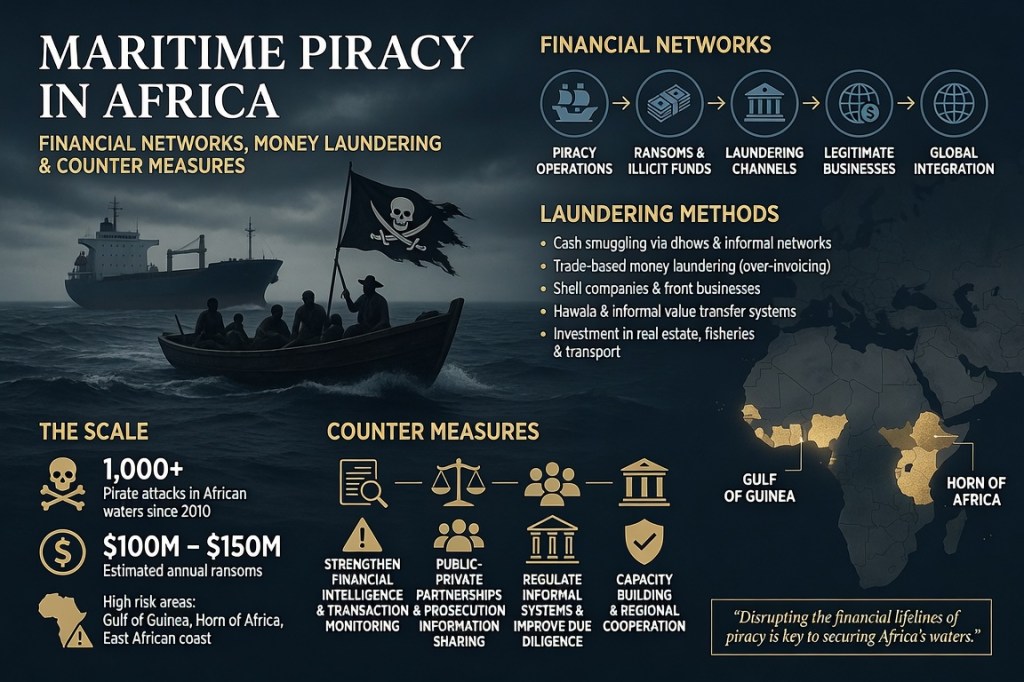
Maritime piracy in Africa—centered on Somalia in the Horn of Africa and the Gulf of Guinea in West Africa—has evolved into a sophisticated criminal enterprise that generates hundreds of millions of dollars in illicit revenue. The financial architecture that enables this trade is as complex as the maritime operations themselves, relying on informal value transfer systems, cross-border cash smuggling, trade-based laundering, and investments in both legitimate and criminal economies. Between April 2005 and December 2012 alone, Somali pirates claimed more than US$400 million in ransom payments from 179 hijacked ships.
This brief analyzes the money laundering mechanisms that sustain African maritime piracy and presents a comprehensive suite of aggressive, multifaceted solutions targeting the problem at sea, on land, and within the financial systems that enable it. The central argument is straightforward: piracy cannot be defeated through naval patrols alone. Lasting solutions require the systematic destruction of pirate networks ashore, the ruthless pursuit of their financial assets, and the coordinated application of military, legal, and financial pressure across jurisdictions.
Key Statistics – Metric Value
- • Total Ransom Payments (Somali piracy, 2005-2012) US$400 million
- • Average Ransom Value (Peak Period) US$5 million
- • Highest Recorded Ransom US$13.5 million (MV Samho Dream, 2010)
- • Annual Economic Impact (2011 Peak) US$18 billion
- • Annual Ransom Payments (2010) US$238 million
- • Percentage of Ransoms Transferred Out of Somalia 40% to 60%
- • Gulf of Guinea Ransom Payments (2021) US$4 million
- • Financiers’ Share of Ransom 30% to 50%
- • Foot Soldiers’ Share of Ransom 1% to 2.5%
- • Somali Piracy Incidents (Jan-May 2026) 17
- • Percentage of Global Hostages (Somali, 2026) 94%
- • Gulf of Guinea Incidents (Africa, 2025) 72%
- • Global Crew Abductions (Gulf of Guinea, 2025) 92%
The Financial Architecture of Maritime Piracy
The Scale of the Enterprise
Understanding how pirates launder their profits requires first understanding the scale and structure of the piracy economy. At its peak in 2011, Somali piracy cost the global economy an estimated $18 billion annually**, largely through disrupted trade in critical waterways such as the Gulf of Aden. Average ransom values stood at approximately **$5 million at the height of Somali piracy. Ransom payments escalated from an estimated $5 million in 2006 to $180 million by 2010.
For the Gulf of Guinea, while ransom proceeds are comparatively smaller—totaling approximately $4 million in 2021—the region’s piracy is increasingly intertwined with illegal oil bunkering, a multi-billion-dollar industry that provides a far larger financial base for criminal networks. This convergence of maritime crimes complicates the financial picture and makes money laundering detection significantly more challenging.
The Distribution of Ransom Proceeds: Who Gets What
The ransom money is not distributed equally among pirates. A clear hierarchy exists, and understanding this distribution is essential for targeting the financial networks that sustain piracy.
Pirate Financiers — “The Money Kingpins”
Standing at the apex of the piracy network are the financiers—investors and beneficiaries who collect 30% to 50% of total ransom, working individually or as groups. These are not the young men who board ships with AK-47s; they are sophisticated criminal entrepreneurs who underwrite piracy operations, arrange logistics, and manage the complex financial transfers required to move millions of dollars across borders. They are the primary target for any serious anti-money laundering effort.
Low-Level Pirates — The Foot Soldiers
The pirates who actually conduct the hijackings receive a standard fee of US$30,000 to US$75,000 per ship, which amounts to only 1% to 2.5% of an average ransom payment. These are often young men and teenagers who act as maritime militia. While their individual shares are modest, the cumulative effect across multiple operations has created what the UN has termed a “pirate economy” in parts of Somalia.
The Support Economy
The local community provides goods and services to pirates, including food, repair services, and khat (a legal drug in Somalia). Ground militia who control the territory where hostages are held also receive a share. Hundreds of people in north-eastern and central Somalia are employed by this piracy economy, all requiring their share of each ransom. A UN report based on information from pirates in the village of Eyl revealed that maritime militia receive approximately 30% of ransom, while ground militia and other supporters receive the remainder.
The Broader Ecosystem
Beyond the pirates themselves, a vast industry of facilitators has emerged: security companies, lawyers, negotiators, and intermediaries all reap substantial profits from their involvement in ransom negotiations and payments. This ecosystem creates perverse incentives for the continuation of piracy, as many actors have a financial interest in its persistence.
The Hawala System: Piracy’s Financial Backbone
The single most important mechanism for moving and laundering pirate proceeds is the hawala system—an informal value transfer system that operates on trust, honor, and verbal transactions rather than documentation. Because Somalia has no functioning formal banking sector, hawala has become one of the only methods of financial transaction in the country.
Why Hawala is Ideal for Pirates
The hawala system presents near-insurmountable challenges for law enforcement:
- No Paper Trail: Most transactions are done verbally, making it “almost impossible to find out what happens to money made from ransom payments or any other transaction in Somalia”.
- Cash-Based: Most ransoms are paid in cash, which “simply disappear into the Somali community, rather than ending up in banks or other financial bodies”.
- Global Reach: The Somali diaspora is present across the globe—in Kenya, the UAE, Saudi Arabia, Britain, the Netherlands, Canada, the United States, and Australia—and the hawala system uses this network to transfer funds. Agents use this expatriate network to move money from one country to another with minimal oversight.
- Community-Based: Because hawala is community-based and typically used for legitimate commercial purposes and remittances, separating legitimate transactions from illicit ones is extraordinarily difficult.
Black Hawala
The legitimate hawala system has been “perverted by persons involved in piracy activities, who take advantage of the ‘underground’ nature of this system to launder the funds obtained from ransoms”. This “black hawala” involves using the informal transfer system specifically for illegitimate purposes such as money laundering. Financiers backing pirates arrange complex multibank transfers, disbursing ransom money through dozens of institutions around the globe within hours.
Methods of Moving and Laundering Pirate Proceeds
The World Bank, in collaboration with INTERPOL and UNODC, identified several primary methods by which pirate proceeds are moved, invested, and used:
Cross-Border Cash Smuggling
Cash is physically smuggled across the porous borders of the Horn of Africa region. One pirate was documented taking $12,000 in $50 and $100 bills to a money transfer office and wiring it abroad. The lack of effective border controls in the region makes this method particularly difficult to interdict.
Trade-Based Money Laundering
Pirate financiers invest in import-export businesses, using legitimate commercial activities to commingle illicit funds with legitimate revenue. The khat trade, particularly in Kenya, is especially vulnerable to this risk because it is not effectively monitored.
Bank Wire Transfers
Despite the challenges of Somalia’s failed state, wire transfers remain a key method for moving funds out of the country. While hawala companies in the West and Arab world have become more regulated, tracking money once it enters Somalia remains extremely difficult.
Abuse of Money of Value Transfer Services
Beyond hawala, other money transfer services are exploited. Mobile money platforms and cryptocurrencies are increasingly used to move funds. The Financial Action Task Force (FATF) has documented how international financial institutions’ implementation of anti-money laundering standards forces criminals to seek alternative methods for laundering illicit proceeds.
Investment of Pirate Proceeds: Legitimate and Criminal
Contrary to conventional wisdom, many investments of piracy proceeds are actually made within Somalia. Satellite imagery analysis shows that significant amounts of ransom money are spent in Somali cities such as Garowe and Bosasso, which also provide “the material inputs and the ‘fire power’” for piracy operations. Nightlight emissions—an excellent proxy for local economic activity in statistically challenged countries—confirm that pirates invest principally in these urban centers rather than in backward coastal communities.
Legitimate Investments
- Real Estate: This is the primary investment sector. Pirates buy houses, buildings, and other estates. In some regional countries, extensive property acquisition has significantly increased market prices and made access to property extremely expensive for local populations.
- Legal Businesses: Import-export businesses, telephone shops, and other commercial enterprises are established in many countries, including nations in the Global North.
- Regional Investments: Pirates launder “huge sums through property, hotels, shopping arcades and trucking companies in Kenya,” according to family members, real-estate brokers, and investigators.
Criminal Reinvestment
- Further Piracy Acts: Proceeds are recycled into financing additional piracy operations.
- Human Trafficking and Migrant Smuggling: Piracy profits flow into these adjacent criminal enterprises.
- Militias and Military Capacities: Ransom money is invested in armed groups on land in Somalia.
- Weapons and Technology: Investments include weapons, GPS and VHS radios, fast fiberglass boats, and satellite cell phones.
- Drugs and Alcohol Smuggling: Ransom money is reinvested into drug, weapons, and alcohol smuggling.
The Cross-Border Dimension
It is estimated that 40% to 60% of ransoms are transferred out of Somalia. Based on the $238 million in ransoms paid in 2010, approximately $95 million was transferred out of the country that year alone. The main reported locations of pirate financiers’ assets include Djibouti, Ethiopia, Kenya, Seychelles, and the UAE. Dubai and other Gulf states have been identified as key hubs for laundering operations, though these allegations have been strenuously denied by officials in the region.
The Opacity Problem
The financial opacity of the piracy economy cannot be overstated. As one maritime security expert observed: “What happens to the money is exceedingly opaque, partly because of the way Somalis communicate with each other, and also because of the impenetrable way their finance system works”. This opacity has led some security experts to suggest that the international criminal dimensions of Somali piracy are exaggerated by private security companies seeking to drum up business. However, the evidence of substantial cross-border financial flows and investments in multiple countries suggests that the threat is real.
Gulf of Guinea: A Different Financial Landscape
The Gulf of Guinea presents a different financial picture. Unlike Somali piracy, which focuses on ship hijacking for ransom, Gulf of Guinea piracy encompasses multiple criminal activities:
- Kidnapping for Ransom: Crew members are kidnapped and held for ransom.
- Cargo Theft: Particularly theft of oil cargo.
- Illegal Oil Bunkering: A multi-billion-dollar industry that dwarfs ransom proceeds.
The Inter-Governmental Action Group against Money Laundering in West Africa (GIABA) has documented how “illicit financial flows function not only as enablers and facilitators, but also as an end to criminal activities in the region”. Criminal acts will continue “as long as there are illicit financial flows so that the gains for the criminals are well worth the risk of arrest and prosecution”.
In the Gulf of Guinea, money laundering is linked to a broader array of crimes: drug trafficking, human trafficking, arms smuggling, illegal fishing, and crude oil theft. This criminal convergence means that targeting piracy requires addressing the entire illicit financial ecosystem. Terrorism financing, piracy, illicit financial flows, and cyber-enabled fraud have become “increasingly interconnected, requiring a unified regional response backed by robust intelligence-sharing and stronger financial oversight mechanisms”.
Aggressive Solutions — A Comprehensive Strategy
The resurgence of Somali piracy in 2023-2026—with at least 17 piracy-related incidents in Somali waters or the Gulf of Aden between January and May 2026 alone—demonstrates that previous counter-piracy efforts, while successful in suppressing attacks for nearly a decade, failed to achieve a permanent solution. The piracy epidemic was previously “solved only through sustained collaboration by the international community, with entities like NATO, the EU, and the Combined Maritime Task Force launching aggressive counterpiracy operations”. But that collaboration has waned, and piracy has returned.
The following sections outline an aggressive, multi-domain strategy that addresses piracy at sea, on land, and in the financial systems that enable it.
Maritime Operations: Aggressive Naval and Military Action
Enhanced Naval Presence and Coordination
The first line of defense remains robust naval presence. Previous success was built on coordinated operations involving NATO, the EU, the Combined Maritime Task Force, and even geopolitical rivals such as Russia and China. A renewed effort must:
- Re-establish the coalition that previously suppressed piracy. As one former NATO supreme allied commander noted, “if Somali pirate assaults rise to the level of 15 years ago, not only should NATO, the EU and African and Arab nations be involved, but we should approach Iran (which has excellent maritime intelligence) and China, which desperately needs the oil transiting the region”. Russia, however, is no longer considered a viable partner.
- Expand Operation Atalanta’s mandate to include not only counter-piracy but also response to “illicit maritime flows, including illicit trade financing terrorism”.
- Improve maritime domain awareness through technology, including satellite surveillance, automatic identification systems, and intelligence sharing.
Armed Security on Merchant Vessels
The shipping industry must be required—not merely encouraged—to embark armed security details from private firms. While the International Maritime Organization can help organize convoys and push for armed security, this should be mandated through flag state regulations. The cost of armed security is minimal compared to the cost of ransom payments and the disruption to global trade.
Aggressive Interdiction and Pursuit
Naval forces must adopt more aggressive Rules of Engagement. While “limited use of force” previously helped suppress piracy, the resurgence requires a more robust posture:
- Target mother ships—the larger vessels that enable pirates to operate hundreds of miles offshore. Destroying these vessels cuts off pirates’ operational reach.
- Pursue pirates onto land when necessary. As one analysis notes, “the only lasting solutions lie ashore. The first step would be tactical military enforcement—sending armed special forces and Marines ashore to destroy the pirates’ maintenance facilities; break up logistic chains for their fuel and ammunition; and capture pirate leadership”.
- Disrupt pirate logistics by targeting fuel supplies, ammunition caches, and communication equipment on land.
The Puntland Model
Puntland’s Maritime Police Force (PMPF) has demonstrated effectiveness through “aggressive, multi-front campaigns to contain this externally fueled threat”. International support for regional maritime security forces like the PMPF should be significantly expanded. These local forces understand the terrain, the networks, and the cultural dynamics in ways that external forces cannot match.
Land Operations: Attacking the Root Cause
Direct Action Against Pirate Infrastructure
Piracy cannot be defeated at sea alone. The pirate bases, maintenance facilities, fuel depots, and command centers are located on land in Somalia. Aggressive solutions must include:
- Airstrikes and Special Forces Raids against known pirate facilities and leadership compounds. While controversial, such actions send an unmistakable message that there is no safe harbor for pirates.
- Destruction of Logistics Chains: Target the fuel supplies, ammunition stores, and communication equipment that enable piracy operations.
- Capture of Pirate Leadership: Removing the financiers and commanders—the “Money Kingpins”—is more effective than arresting low-level foot soldiers.
Governance and Rule of Law
International naval cooperation has “helped suppress rather than eradicate piracy—a task that requires Somalia’s federal government and its partners to reverse governance gaps and strengthen capacity for maritime security”. Specific actions include:
- Support for Somalia’s Anti-Piracy Law: Somalia’s House of the People approved a revised Anti-Piracy and Anti-Kidnapping Bill in late 2025, “a milestone in the country’s effort to modernize its maritime security framework and align with international law”. International partners must provide the technical and financial resources to implement this law effectively.
- Strengthening Coastal Policing: Establish permanent coast guard stations along Somalia’s lengthy coastline to prevent pirates from establishing shore bases.
- Alternative Livelihoods: The piracy economy employs hundreds of people. Developing alternative livelihoods—particularly in fishing, aquaculture, and port-related industries—is essential to drain the pool of potential recruits. However, as the UN Secretary-General noted, the “pirate economy” in parts of Somalia has become so entrenched that it is “resistant to efforts to develop alternative livelihoods”. This resistance demands more aggressive economic interventions.
Countering Criminal Convergence
In the Gulf of Guinea, piracy is increasingly linked to illegal oil bunkering, drug trafficking, and other crimes. Addressing maritime piracy requires addressing this criminal convergence:
- Nigeria’s Deep Blue Project provides a model. Established in 2021 to combat piracy, sea robbery, illegal fishing, oil theft, and other maritime crimes, the project has transformed Nigeria’s maritime security landscape. The project credits its monitoring and protection efforts for a “steep drop in piracy incidents and a delisting in 2022 from a public roster of the world’s piracy problem areas”. This model should be replicated across the Gulf of Guinea.
- Regional Maritime Task Forces: The proposed Combined Maritime Task Force for the Gulf of Guinea would strengthen regional cooperation. Sustained regional efforts have already curbed piracy in the Gulf, but recurring kidnappings demonstrate that maritime insecurity remains a threat.
Financial Warfare: Dismantling the Piracy Economy
Following the Money: The Central Insight
As the UN has recognized, “the fight against the trafficking of finances obtained from piracy acts is an essential component in the international anti-piracy strategy”. The international community has acknowledged that “the fight against illicit financing is as important as the fight at high seas”. Without the financial income, piracy cannot survive.
Targeting the Financiers
The pirate financiers who collect 30% to 50% of ransom must be the primary targets of financial warfare:
- Freeze Assets: Identify and freeze the assets of known pirate financiers, including real estate, bank accounts, and business interests.
- Asset Forfeiture: Asset forfeiture mechanisms can “facilitate the seizure of Somali piracy proceeds” and are “applicable to those who directly or indirectly benefited from piracy: the foot soldiers, financiers and other beneficiaries”. By focusing on the funds generated through ransom payments, “a theoretical link between piracy and money laundering is established. This further justifies the utilisation of anti-money laundering laws to confiscate piracy benefits. This removes incentives for piracy, thus indirectly dissuading pirates from engaging in the crime”.
- Unexplained Wealth Orders: Implement laws requiring individuals to explain the source of their wealth when it appears disproportionate to their legitimate income.
Regulating the Hawala System
The hawala system is the Achilles’ heel of Somali piracy. While complete elimination is unrealistic, significant regulation is possible:
- Licensing and Registration: Require all hawala operators to register with financial intelligence units, providing information on their agents, transaction volumes, and customer due diligence procedures.
- Transaction Reporting: Mandate reporting of large or suspicious transactions, similar to requirements for formal financial institutions.
- International Cooperation: Because hawala relies on the Somali diaspora network, international cooperation is essential. Countries with significant Somali populations—Kenya, the UAE, the UK, the US, Canada, and Australia—must coordinate their regulatory efforts.
- Monitoring the Monitors: Establishing Financial Intelligence Units and implementing laws to monitor the hawala system “will hopefully lead to the identification of pirate financiers and the intermediary actors in piracy”.
Strengthening Border Controls
Improved cross-border controls, especially at border entry and exit points, are essential. Specific measures include:
- Cash Declaration Requirements: Mandatory declaration of cash above certain thresholds at borders.
- Enhanced Training: Training border officials to detect cash smuggling and trade-based money laundering.
- Regional Intelligence Sharing: Sharing financial intelligence across the region to track the movement of illicit funds.
Combating Trade-Based Money Laundering
Trade-based money laundering—through import-export businesses, the khat trade, and other commercial activities—requires specialized investigation:
- Monitor High-Risk Sectors: The khat trade, real estate, and telecommunications are particularly vulnerable.
- Price Verification: Verify that import and export prices reflect market values to detect over- and under-invoicing.
- Beneficial Ownership Transparency: Require disclosure of the true owners of businesses to prevent pirates from hiding behind shell companies.
International Legal Frameworks
- Criminalize Financing of Piracy: As the UN Secretary-General urged, more nations must criminalize piracy—“including by deterring and suppressing the financing of piracy and the laundering of ransom money”.
- Money Laundering as a Predicate Offense: U.S. authorities have demonstrated that “piracy activities could form the basis of money laundering charges relying on other predicate offenses such as theft from interstate shipment”. This approach should be adopted globally.
- Prosecutions: Between 2008 and 2012, 1,116 young Somali men faced criminal proceedings for piracy in 20 countries around the world, while 688 were dealt with in the region. These prosecutions must continue and expand.
The Role of the Financial Action Task Force
The Financial Action Task Force (FATF) has recognized “organized maritime piracy and related kidnapping for ransom” as a money laundering and terrorist financing threat. FATF standards should be applied rigorously to jurisdictions that facilitate piracy-related money laundering. Countries that fail to implement adequate anti-money laundering measures should face financial sanctions.
Legal and Judicial Measures
International Prosecution and Deterrence
The transnational nature of piracy demands international judicial cooperation:
- Establish Specialized Piracy Courts: Dedicated courts in the region—similar to the piracy courts established in Kenya and Seychelles—with jurisdiction over piracy and piracy-related financial crimes.
- Extradite and Prosecute: Pirate financiers and leaders should be extradited to countries willing to prosecute them. The U.S. sentencing of Somali pirate Abduwali Muse to over 33 years in prison for his role in hijacking the Maersk Alabama demonstrates that significant sentences are possible.
- Prosecute Money Laundering: Focus prosecution efforts on the financiers and money launderers, not just the foot soldiers. The money laundering charges carry longer sentences and target the individuals who make piracy profitable.
Asset Recovery
- International Asset Recovery: Coordinate asset recovery efforts across jurisdictions to seize pirate assets wherever they are located.
- Victim Compensation: Use seized assets to compensate victims of piracy and their families.
- Incentivize Cooperation: Offer rewards for information leading to the identification and seizure of pirate assets. The U.S. has offered $10 million for information on ISIS-Somalia’s financial network; similar rewards should be offered for information on pirate financiers.
Regional and International Cooperation
The Critical Role of Regional Institutions
The African Integrated Maritime Strategy provides a framework for cooperation. Specific regional actions include:
- The Yaoundé Code of Conduct: This framework for Gulf of Guinea maritime security must be fully implemented and resourced.
- GIABA: The Inter-Governmental Action Group against Money Laundering in West Africa must expand its focus on maritime crime.
- Friends of the Gulf of Guinea: This coordinating mechanism should be strengthened.
International Support
- UN Support: The UN Security Council has recognized that piracy “exacerbates instability in Somalia by introducing large amounts of illicit cash that fuels additional crime, corruption, and terrorism”. This recognition must translate into sustained action.
- World Bank and UNODC: These institutions have provided essential research on illicit financial flows. Their work must continue and expand.
- Private Sector Engagement: The shipping industry, insurance companies, and financial institutions all have a stake in eliminating piracy. Their cooperation is essential.
A Call to Action
The resurgence of piracy off the Horn of Africa and the persistent threat in the Gulf of Guinea demand a response that matches the scale and sophistication of the threat. Naval patrols alone are insufficient. The “three-pronged approach” that previously defeated Somali piracy—international naval cooperation, shipping industry engagement, and onshore capacity building—must be resurrected and expanded to include aggressive financial warfare.
The Cost of Inaction
The cost of inaction is staggering. At its peak, Somali piracy cost the global economy $18 billion annually. Ransom payments have totaled hundreds of millions of dollars. The illicit cash from piracy “fuels crime, corruption and terrorism”. The laundering of piracy money causes “steep price rises in the Horn of Africa” and is “reinvested into criminal activities such as drugs, weapons and alcohol smuggling as well as human trafficking”.
The Path Forward
The path forward requires:
- Military Aggressiveness: Send armed forces ashore to destroy pirate facilities, break up logistics chains, and capture pirate leadership.
- Financial Ruthlessness: Systematically target the financiers who make piracy profitable, using asset forfeiture, money laundering prosecutions, and international cooperation to seize their assets.
- Regulatory Determination: Regulate the hawala system, strengthen border controls, and implement anti-money laundering measures across the region.
- Judicial Persistence: Prosecute pirates—and especially their financiers—in national and international courts, imposing sentences that deter others.
- Regional Cooperation: Strengthen regional institutions and maritime security forces, providing them with the resources and training they need to succeed.
- International Commitment: Rebuild the international coalition that previously defeated Somali piracy, recognizing that this is a global problem requiring a global response.
Conclusion
Maritime piracy in Africa is not primarily a maritime problem—it is a financial crime enabled by failed governance, poverty, and the absence of effective financial regulation. The hawala system, cross-border cash smuggling, and trade-based money laundering provide the financial infrastructure that makes piracy profitable. The financiers who collect 30% to 50% of every ransom are the true engines of the piracy economy.
Defeating piracy requires attacking these financial networks with the same intensity that naval forces attack pirate skiffs at sea. It requires sending special forces ashore to destroy pirate infrastructure and capture leadership. It requires regulating the hawala system, freezing pirate assets, and prosecuting money launderers. It requires regional cooperation, international commitment, and the sustained application of military, legal, and financial pressure.
The tools to defeat piracy exist. What has been lacking is the political will to use them aggressively and comprehensively. The resurgence of Somali piracy in 2023-2026 should serve as a warning: without a sustained, aggressive, multi-domain strategy, the pirates will return—and the cost to global trade, regional stability, and human security will be immense.
The fight against piracy must be fought at sea, on land, and in the financial systems that make it profitable. Anything less is merely containment. And containment, as recent events have demonstrated, is not enough.
Orlando “Andy” Wilson
Obsidian Research Bureau
Book on Amazon!
Intelligence Gathering: Front Line HUMINT Considerations
The things I talk about in this book are double-sided; can be used totarget others or used against you.
Audio Book @ https://www.amazon.com/dp/B0DJMW8SM5
Kindle @ https://www.amazon.com/dp/B086WPL4XS
Paper Back @ https://www.amazon.com/dp/B086PN2KLQ
Hard Cover @ https://www.amazon.com/dp/B0FK25TC7D

