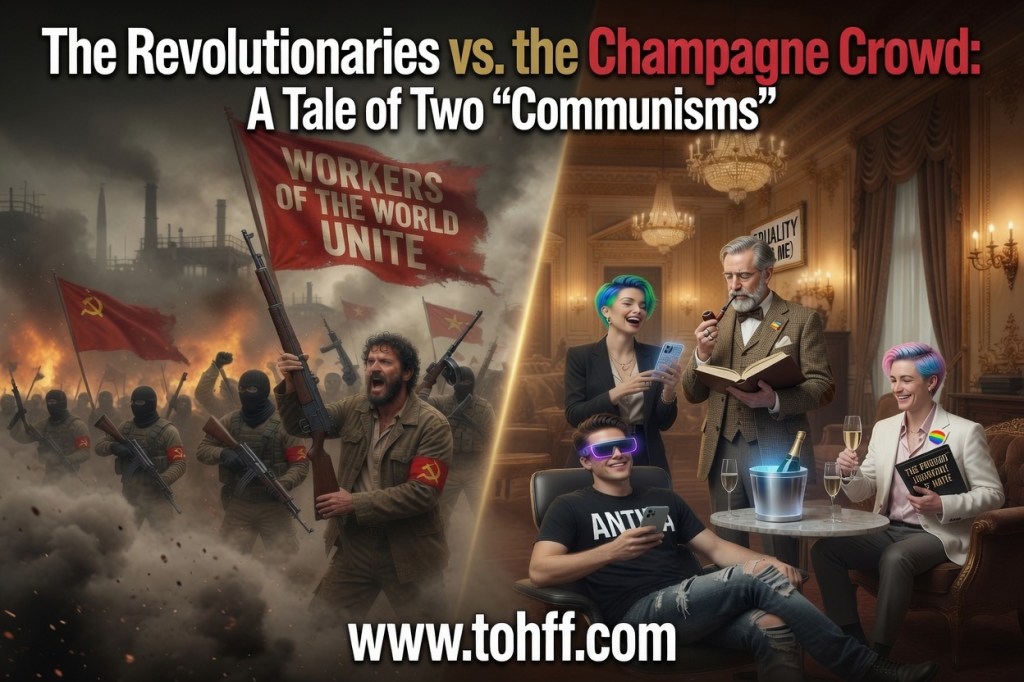
There exists a chasm so vast between the communist revolutionaries of the Revolutionary Era (c. 1917-1923) and today’s wealthy poseurs—whether Hollywood celebrities or trust-fund ANTIFA activists—that the comparison itself borders on sacrilege. On one side stand factory workers who gave their lives, their freedom, and their last scrap of bread for a cause they believed would liberate humanity. On the other stand millionaires in designer sunglasses preaching redistribution from private yachts, alongside university-aged activists with green hair and ripped designer denim, sipping ten-dollar oat-milk lattes in gentrified coffee shops while tweeting calls for violent revolution from their titanium iPhones. This is not merely a difference of degree—it is a difference of ontological essence, a betrayal so complete that the word “communist” has fractured into two utterly irreconcilable meanings.
The Revolutionaries: Workers Who Paid in Blood
The communist revolutionaries of the Revolutionary Era were, first and foremost, workers. They emerged from factory floors slick with grease, from dockside gangs with cracked hands, from the ranks of the unemployed and the destitute who had never known a full stomach. In Russia, when the Bolshevik Revolution ignited, the Communists did not merely preach sacrifice—they personified it. William Zebulon Foster, writing in 1921, documented a harrowing statistic: of the total number of Communists in Russia when the revolution began, not more than 20 percent were still alive. This was not rhetorical hyperbole; it was a ledger of the dead.
The sacrifice was total and without limit. During the Kronstadt uprising, the Communist Party congress mobilized some 300 of its members and dispatched them to the front. Half of them never returned. Foster observed that “the Communists have sacrificed themselves without stint or limit” and that “they work harder and live simpler than anyone else in Russia.” These were not people who enjoyed privilege; they were people whose very existence was a liability. Whenever counter-revolutionary generals captured territory, “they always killed every Communist they found”—not imprisoned, not exiled, but summarily executed.
This pattern echoed across continents. In Ireland, young communist militants like Liam O’Flaherty (aged 25), Jim Phelan (26), and Sean McEntee (27) led armed occupations of public buildings to fight for the unemployed. They were not wealthy activists dabbling in radical chic; they were the living embodiment of “the 30,000 anonymous unemployed workers and their dependents living on the breadline in Dublin.” Their demand was stark and urgent: work or full maintenance. They lived the hunger they sought to end. In Brazil, anarchists and communists engaged in struggles “marked by adventure and suffering, jailbreaks and long marches, and death in the backlands.” In America, communist workers were “literally strangl[ed]” by the bourgeoisie, unable to find work, rotting in “close stone cells.”
Grigorii Zinoviev, opening the Second Congress of the Communist International in 1920, spoke not of abstract theory but of living comrades “who have perished for the cause” and those “languishing in the German, Hungarian, French, British, and American prisons.” There was no nation “in which the blood of the Communist workers, and the best leaders of the working class, has not flowed.” These revolutionaries walked the path they preached. Their “uniform” was a threadbare work shirt; their “coffee” was water or cheap vodka to dull the pangs of starvation; their “smartphone” was a mimeographed pamphlet distributed at the risk of the firing squad.
The Poseurs: From Gucci Communists to Green-Haired Trust-Fund Activists
Fast forward a century, and the archetype of the “revolutionary” has devolved into a grotesque caricature. Today’s landscape is populated not by dockworkers but by two equally laughable figures: the champagne socialist celebrity and the ANTIFA kid with green hair, living off Daddy’s trust fund.
Consider the phenomenon of the “Gucci communist”—a term so fitting it has become global slang. These are individuals who “publicly align with leftist or communist principles while openly displaying symbols of obscene wealth.” In Italy, they are mockingly called comunisti col Rolex (communists with Rolex). Similar epithets abound: “cashmere communist,” “Neiman Marxist,” “smoked salmon socialist.” Representative Ilhan Omar, a self-proclaimed Marxist, has been photographed sporting Jimmy Choo, Oliver Peoples, and Prada sunglasses worth up to $500 each, while her net worth reportedly balloons toward $30 million. Fidel Castro’s grandson, Sandro, sips Cristal beer aboard yachts and hosts parties where entry fees are “hundreds of times what most Cubans earn in a month.” Multi-millionaire hedge fund managers fund “communist” think tanks from their $20 million townhouses.
But the most glaring, and perhaps most insufferable, iteration of this hypocrisy is the modern ANTIFA activist. Picture the scene: an expensive, minimalist coffee shop in a gentrified urban neighborhood. The floors are polished concrete, the ambient music is lo-fi hip-hop, and the oat-milk lattes cost $10.50. There, perched on a reclaimed-wood stool, sits the revolutionary of 2026. Their hair is dyed electric green—a costly, high-maintenance dye job that requires salon visits. Their clothing is deliberately “distressed”: ripped designer jeans that cost $400, a vintage-band t-shirt curated from a high-end boutique, and pristine white sneakers that have never touched a factory floor. In their hand is the latest iPhone Pro Max, its camera array pointing outward to capture the perfect angle for their next Instagram story.
This is the new front line of the revolution. They do not march through the mud of the Donbas; they march through the pristine aisles of Whole Foods. Their struggle is not against starvation; it is against the microaggressions of their university professors. Their weapon is not a rifle seized from an armory; it is the smartphone, through which they draft scathing tweets about “eating the rich”—entirely oblivious to the fact that their father’s hedge fund, or their mother’s real estate empire, is paying for their unlimited data plan and the $10 latte they are clutching.
Let us dissect the sheer weight of this hypocrisy. The $10 coffee they sip is a luxury that would have fed a striking Dublin family for a week in 1922. The ripped designer jeans—manufactured in a sweatshop they claim to oppose—cost more than a Russian factory worker’s entire monthly wage during the civil war. They denounce fascism (ANTIFA stands for Anti-Fascist Action) yet have never faced a single fascist bullet, baton, or prison sentence. They preach the overthrow of capitalism while actively enriching the ultimate capitalist behemoths: Apple (for the iPhone) and Starbucks (for the latte). They call for the abolition of inherited wealth while being its primary beneficiaries. They demand everyone else sacrifice their comforts, yet they will not sacrifice their avocado toast.
The Core Difference: Authenticity, Work, and Genuine Risk
What fundamentally separates the 1920s revolutionaries from today’s green-haired, iPhone-wielding performative activists is not merely wealth—it is the relationship between word, deed, and labor.
For the Revolutionary Era communist, joining the cause meant sacrifice—of comfort, of safety, of life itself. For the modern activist, joining the cause means acquisition—of social capital, of moral superiority, of a fashionable subcultural identity. The revolutionary’s communism was a life-or-death commitment; the activist’s communism is a lifestyle aesthetic, interchangeable with veganism or vinyl record collecting.
The revolutionaries were organically connected to the working class because they were the working class. Their hands bore calluses from physical labor; their backs ached from factory shifts; their stomachs growled from genuine malnutrition. They did not advocate for the poor from a distance; they were the poor. Today’s wealthy activists advocate for the working class from a position of such immense privilege that they have likely never washed a dish professionally, never hauled cargo, never faced an eviction notice. Their “work” consists of tweeting, marching safely behind police barricades, and attending grievance-studies seminars.
The revolutionaries faced real, tangible consequences. Imprisonment, execution, torture, exile—these were not abstract boogeymen but daily statistical realities. When Zinoviev spoke of comrades in prison, he was naming specific souls in specific cells. Today’s ANTIFA kid faces no such consequences. The greatest “oppression” they encounter is being asked to wear a mask or having their Wi-Fi cut out during a Zoom call. They can tweet about revolution, turn off their phone, and retreat to the safety of their parents’ suburban mansion. There is no Cheka kicking down their door; there is only a DoorDash delivery arriving with their dinner.
Perhaps most damning is the material contradiction that defines their existence. The 1920s communist lived simply not because simplicity was fashionable, but because simplicity was the only option. Foster noted that “the Communists are not among those pastors who point out to others the steep and thorny path to Heaven, while they themselves the primrose path of dalliance tread.” Today’s trust-fund activist does precisely that: they tread the primrose path of privilege while loudly pointing the working class toward the steep and thorny path of austerity. They demand the destruction of a system that has gi2} even them everything, while simultaneously refusing to give up any of its fruits.
Conclusion
The difference between the communist revolutionaries of the Revolutionary Era, and today’s green-haired, designer-clad, latte-sipping, iPhone-tweeting activists is not merely a matter of degree but of diametric opposition. One group sacrificed everything for a cause; the other uses a cause to acquire everything. One group lived and died alongside the workers they sought to liberate; the other preaches revolution from air-conditioned coffee shops and gated communities. One group’s commitment was measured in blood and prison sentences; the other’s is measured in retweets and Instagram engagement.
The revolutionaries of the 1920s understood that communism was not a brand to be worn or a hashtag to be deployed. It was a struggle to be lived, often unto death. They did not seek to accumulate wealth while advocating its abolition; they renounced wealth precisely because they believed in its abolition. Their suffering gave their words weight. Their sacrifice gave their cause credibility.
Today’s performative activists, by contrast, have drained the ideology of its soul. When a millionaire in designer sunglasses tells you to redistribute wealth, the message rings hollow. When a green-haired kid who has never held a job, whose ripped jeans cost more than a car, tweets about smashing the state while sipping a $10 latte, the hypocrisy is nauseating. These are not revolutionaries; they are LARPers (Live Action Role Players). They are tourists in a struggle they fundamentally do not understand. And the performance, however fashionable, is a profane insult to every illiterate, starving, executed worker who ever genuinely gave their life for the cause of human liberation.
Books on Amazon
The Mountains of Fire: A Military History of the Balkan Partisans, 1941-1945
When the Axis powers invaded Yugoslavia and Greece in April 1941, they expected a quick victory. Instead, they ignited a firestorm of resistance that would consume the Balkans for four years, a war of guerrillas and collaborators, of heroes and war criminals, of liberation and genocide.
Kindle @ https://www.amazon.com/dp/B0HDGVHP4C
Paperback @ https://www.amazon.com/dp/B0HDKYDFLK
Hardcover @ https://www.amazon.com/dp/B0HDL8H5CQ
Communist

