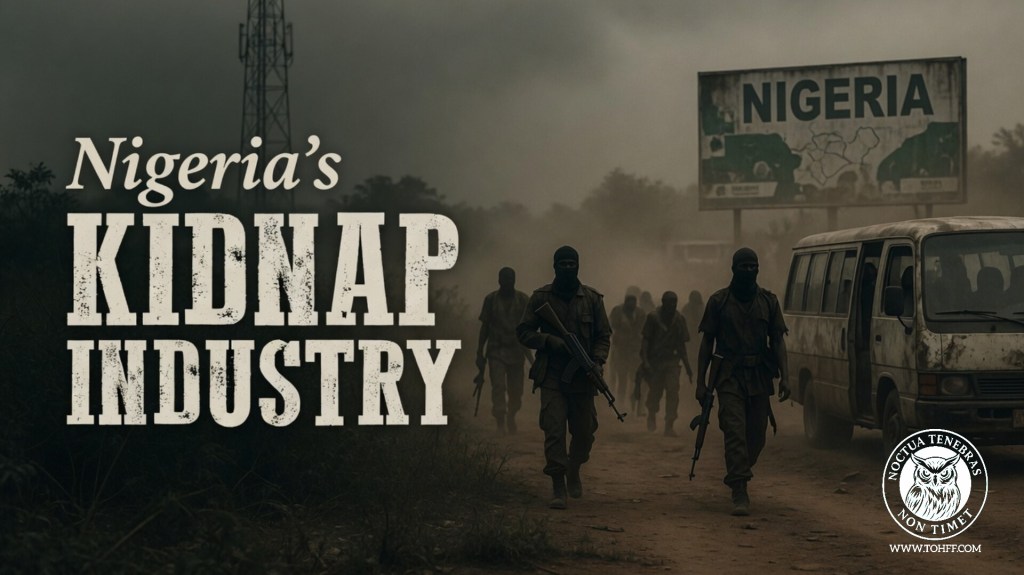
It’s a scenario that has become painfully familiar across Nigeria: a phone call in the middle of the night, a frantic voice demanding money, and a family plunged into a nightmare that could last weeks, months, or forever. Kidnapping has become one of the most disturbing features of Nigeria’s security crisis—so pervasive that hardly a week passes without reports of people being taken from their homes, intercepted on the road, or abducted while going about their daily activities.
Between July 2024 and June 2025 alone, at least 4,722 Nigerians were abducted across 997 kidnapping incidents, with kidnappers collecting an estimated N2.57 billion ($1.66 million) in ransom payments. Behind those figures are thousands of individual tragedies—families selling property, borrowing money, and in many cases, still not knowing whether their loved ones will return alive.
But here’s what makes Nigeria’s kidnapping crisis uniquely complex: it is not a single phenomenon. It is a patchwork of regional crises, each driven by different actors, motivations, and methods. To understand the scale of the problem, you have to understand the map.
The Numbers: A Crisis of Staggering Proportions
Let’s start with the scale. According to SBM Intelligence’s report titled “Economics of Nigeria’s Kidnap Industry,” the ransom paid between July 2024 and June 2025 represents just 5.35% of the total N48 billion demanded. The gap between demand and payment underscores a grim reality: kidnappers are inflating their asks, and families are paying whatever they can scrape together.
In 2022, ransom payments of N653 million were valued at $1.13 million. By 2025, payments reached N2.57 billion but were worth only $1.66 million at prevailing exchange rates—a testament to how the naira’s depreciation has made kidnapping a less lucrative business in dollar terms, even as the naira value skyrockets.
The violence is escalating too. At least 762 people died in abduction-related violence during the same period. And this is only what’s reported. Many abductions go unreported, and some victims are killed or remain missing without official records.
The Regions: Four Different Crises, One Country
North-West: The Epicenter of Mass Abductions
If there is a heart of Nigeria’s kidnapping crisis, it beats in the North-West. This region accounts for 425 incidents (42.6% of the national total) and 2,938 victims (62.2% of all abducted persons).
Zamfara State alone recorded 1,203 abductions—more than a quarter of the national total. Kaduna followed with 483 victims, Katsina with 435, and Sokoto and Kebbi added hundreds more.
The perpetrators here are “bandits”—loosely organized local armed groups, often traveling on motorbikes, with no central organization. They operate from vast, poorly governed rural areas and are capable of carrying out large-scale operations with little resistance. Entire villages are often targeted, with victims sometimes forced to work on bandit-controlled farms and mining sites.
These are not ideological fighters. They are criminal enterprises driven by pure economic calculation—and they have found kidnapping to be an extraordinarily profitable business model.
North-East: The Legacy of Insurgency
The North-East tells a different story. Here, the kidnapping crisis is intertwined with the legacy of Boko Haram and ISWAP—Islamist extremist groups that have terrorized the region for over a decade.
Borno State reported 180 abductions during the period under review, a grim reminder of the region’s ongoing insurgency. While less violent than the height of Boko Haram’s insurgency, kidnapping remains a lifeline for armed groups still terrorizing rural communities.
The motivations here blend ideology and financial gain. The infamous Chibok schoolgirls kidnapping in 2014—where 276 girls were abducted from their school, dozens of whom are still missing nearly 12 years later—remains the most powerful symbol of this crisis. Since then, criminal gangs and Islamist militants have abducted no fewer than 1,880 pupils across Nigeria.
South-East: Targeted, Commercial, and Ruthless
In the South-East, the kidnapping economy takes on a different character entirely. Here, abductions are fewer but far more targeted. According to SBM Intelligence, at least 257 people were kidnapped in Nigeria’s South-East between July 2024 and June 2025.
The victims are high-net-worth individuals, travellers, and members of the clergy. In December 2024, Reverend Father Gerald Ohaeri of Nsukka Diocese was kidnapped, with N40 million reportedly paid for his release. In November 2024, a Catholic engineer in Anambra State had N50 million demanded by his abductors.
What makes the South-East particularly chilling is a new trend: paying ransom no longer guarantees safe release. In one case, Mr. Charles Nwolisa, a high-profile businessman, was shot by his abductors in Anambra State in 2023—after they collected the ransom. He survived but fled the country, vowing never to return.
The South-East’s kidnappings are often linked to separatist activities or urban criminal gangs, with Biafran separatist factions active in the region.
South-South: Where It All Began
The South-South region—Nigeria’s oil-producing heartland—is where modern ransom kidnapping in Nigeria actually started. Initially driven by militants seeking to draw attention to resource rights and environmental degradation in the Niger Delta, the practice has since morphed into organized crime.
The scale here is smaller—199 victims recorded—but the sums can be astronomical. In a single case in Delta State, kidnappers demanded N30 billion. Anambra and Delta States recorded 110 and 34 abductions respectively.
South-West: The Least Affected, But Not Immune
The South-West, which includes Nigeria’s commercial capital Lagos, recorded the lowest kidnapping activity—just 5.3% of incidents and 3% of victims. Lagos itself reported 60 abductions. While relatively safer, cases along major highways—particularly the Lagos-Ibadan and Ondo-Ekiti roads—remain a source of concern.
The Roots: Why Kidnapping Thrives
Understanding why kidnapping has become so entrenched requires looking beyond the immediate actors to the underlying conditions that make it possible.
- Poverty and Unemployment: The IMF reported that poverty reached 63% of Nigerians by 2025, with 27 million people facing food insecurity. When legitimate economic opportunities evaporate, crime becomes an alternative livelihood.
- Weak Governance and Corruption: Nigeria’s security institutions are underfunded, understaffed, and riddled with corruption. A government that is corrupt to the extent that “only one person can embezzle what is meant for two million people” loses legitimacy, and people “lose confidence and take to self-help”. The country’s 400,000-strong army and 370,000 police officers are overstretched across multiple crises.
- Vast Ungoverned Spaces: The North-West’s bandits operate from rural areas where the state has little presence. These territories provide safe havens for criminal networks to organize, plan, and hold victims.
- Proliferation of Small Arms: The flow of weapons across Nigeria’s porous borders has armed criminal groups to levels that overwhelm local security forces.
The Consequences: A Nation Held Hostage
The impact of this crisis extends far beyond the victims and their families.
- Education Under Attack: Schools have become prime targets. In the last decade, no fewer than 1,880 pupils have been abducted across Nigeria. At least 816 pupils were abducted in 22 school attacks since January 2023. In November 2025 alone, over 300 children and teachers were abducted from a Catholic School in Papiri, Niger State.
- Economic Devastation: Kidnapping functions like “a regressive tax on already impoverished communities,” reducing crop production, emptying markets, disrupting trade routes, and driving up prices.
- Brain Drain: The crisis has pushed many Nigerians to seek safety abroad. Reports of Nigerians facing tighter scrutiny and denial of entry at foreign borders reflect the reputational damage attached to the Nigerian passport.
- Erosion of Trust: When traditional rulers are abducted and palaces set ablaze—as happened in Kwara State in May 2026—it deepens public anxiety about how far criminal networks have expanded.
Conclusion
Nigeria’s kidnapping crisis is no longer a security problem. It is a full-blown socio-economic “industry”—a structured, profit-driven enterprise that thrives on weak governance, vast unpoliced spaces, poverty, and corruption.
The regional diversity of the crisis—from the mass abductions of the North-West to the targeted commercial kidnappings of the South-East, from the ideological extremism of the North-East to the organized crime of the South-South—makes it resistant to any single solution.
What is clear is that the status quo is unsustainable. As one editorial put it, “If the state cannot keep clean books, secure its people, or restore institutional trust, crime becomes the operating environment”.
Until leadership becomes accountable, security institutions professionalized, and public spending transparent, Nigeria will continue to pay the price—in lives lost, families shattered, and a generation of children denied their education.
The phone calls in the middle of the night will keep coming. And more families will find themselves asking the same desperate question: How do we find the money?.
Remember, we provide a full range of kidnap and ransom prevention services and training!
Books on Amazon
Kidnap & Ransom: The Essentials of Kidnapping Prevention
This book will show you some of the realities of the kidnap and ransom business and give some basic information on what you can do to make yourself a harder target!
Audio Book @ https://www.amazon.com/dp/B0FF37XDKM
Kindle @ https://www.amazon.com/dp/B07BVPQTS7
Paper Back @ https://www.amazon.com/dp/1719057311
Hard Cover @ https://www.amazon.com/dp/B0FKSP91JK

