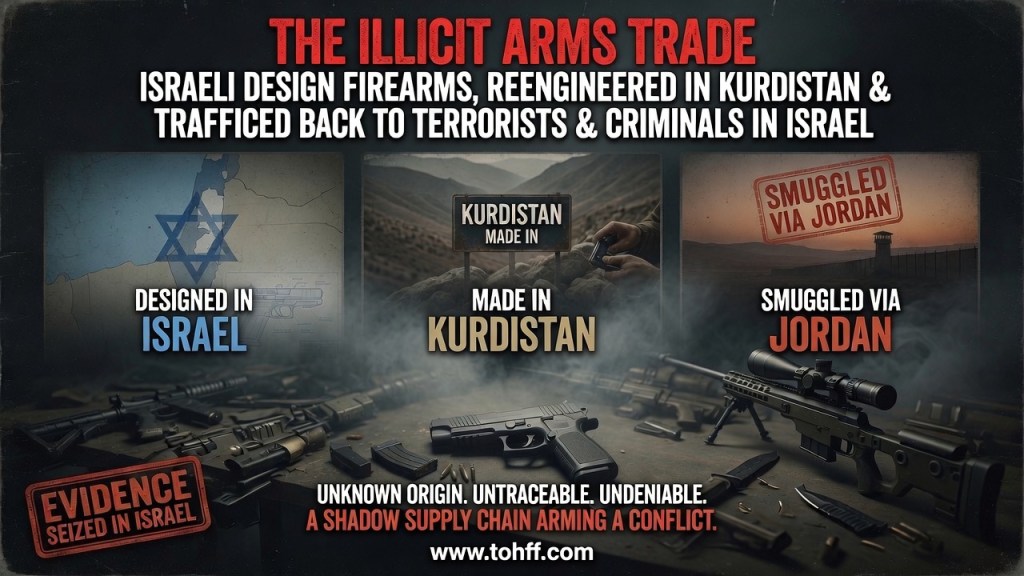
In the shadowy world of international arms trafficking, few stories capture the absurd ironies of modern conflict quite like this one. Israeli-designed pistols—engineered for precision, reliability, and the demanding needs of security forces—are being reverse-engineered in workshops deep in Iraqi Kurdistan, produced in volume, and then smuggled back through Jordanian corridors straight into the hands of criminals and terrorists operating inside Israel itself.
A recent investigation by Haaretz reporter Oded Yaron pulls back the curtain on this improbable supply chain. Hundreds of cloned firearms have already been traced, highlighting vulnerabilities in border security, the persistence of gray-market manufacturing in autonomous regions, and the unpredictable ways defense technology can boomerang against its creators. For those studying low-intensity warfare, private intelligence, or the hidden architecture of power, this case offers a masterclass in how conflict ecosystems adapt and exploit every available seam.
Click Here For The Haaretz Story
The Factory That Shouldn’t Have Been
The story traces back roughly a decade, to a weapons manufacturing initiative established in Iraqi Kurdistan near the Iranian border. The region’s ruling political entities provided the political cover, while financing flowed from influential local conglomerates. Day-to-day management was initially handed to an unlikely figure: Ross Roggio, a Pennsylvania-based former U.S. Army paratrooper with ambitions of building a modern arms production hub in Sulaymaniyah.
Roggio’s venture was ambitious. He pitched production of M4-style automatic rifles and Glock-like 9mm pistols, leveraging illegally exported U.S. components, tools, and technical know-how. Backed by connections within the Patriotic Union of Kurdistan (PUK) — including figures tied to the Talabani family — the operation appeared poised to serve regional security needs, such as arming Peshmerga forces or generating economic activity in a volatile area.
Instead, it devolved into a saga of fraud, smuggling, and brutality. In 2015, when an Estonian employee at the facility raised concerns and threatened to expose irregularities, Roggio allegedly orchestrated his abduction by Kurdish soldiers. The victim endured 39 days of horrific abuse at a military compound: suffocation with a belt, threats of finger amputation, repeated beatings, tasings, choking, and psychological torment. Roggio was hands-on in directing much of it.
U.S. authorities eventually caught up. In 2023, Roggio was convicted on dozens of counts including torture, conspiracy to commit torture, illegal arms exports, wire fraud, and money laundering. In April 2024, he received a 70-year federal prison sentence—one of the rare applications of the U.S. federal torture statute. Prosecutors described him as a serial fraudster whose schemes spanned multiple continents. Weapons and parts from his operation reportedly reached militant groups, including echoes that later connected to broader flows.
The factory itself, however, did not vanish with Roggio’s downfall. Production capabilities in the region persisted or evolved. According to the Haaretz probe, the focus shifted—or parallel workshops emerged—toward reverse-engineering popular Israeli pistol designs. Kurdish technicians, drawing on captured examples, technical specifications, or skilled machining, began producing functional clones. These were not crude copies but serviceable replicas leveraging the original ergonomics and reliability that made Israeli handguns favorites among professionals.
From Workshop to Smuggling Pipeline
Once manufactured, the pistols enter a well-established trafficking network. Iraqi Kurdistan’s location offers multiple exit routes, but the primary vector identified is through Jordan. From there, weapons cross into Israel via land borders that, while monitored, remain porous enough for determined smugglers—often involving Bedouin networks with deep knowledge of desert passages.
Recent years have seen an evolution in tactics. Traditional mule caravans and vehicle concealment have been supplemented by drones, which Israeli forces have intercepted carrying handguns and even heavier ordnance along the Jordan frontier. Seizure numbers have climbed steadily: dozens to hundreds annually, with spikes in certain periods. The cloned Israeli pistols fit perfectly into this ecosystem—compact, high-value, and difficult to trace once serial numbers are ground off or falsified.
The scale is notable. Haaretz reports that hundreds of these specific firearms have been trafficked and recovered in Israel. Many are diverted to criminal organizations fueling street violence, while others strengthen terrorist cells, particularly in the West Bank, where they augment existing arsenals used in attacks.
Impact on Israeli Security and Society
Israel already contends with multiple arms inflow vectors—from Sinai, maritime routes, and internal diversion of legal weapons. The Kurdish-Jordanian channel adds a particularly vexing dimension because it exploits a border with a formal peace partner. Jordan has cooperated on security matters, but the volume of smuggling underscores gaps in joint interdiction and intelligence sharing.
For Israeli police and the IDF, these clones represent both a tactical and symbolic threat. Criminal use contributes to soaring gun violence in certain communities. In terrorist hands, they enable assassinations, ambushes, and sustained operations. The psychological sting is unmistakable: weapons born from Israeli innovation now turned against Israeli targets after a circuitous journey through former (and current) conflict zones.
This feeds into larger patterns of low-intensity conflict. Non-state actors thrive by piecing together disparate supply chains—state sponsors, black-market entrepreneurs, and opportunistic manufacturers. The clones may lack the full quality assurance of originals, but in close-quarters urban fighting or criminal hits, they are more than adequate. Their untraceable nature complicates attribution and prosecution.
Deeper Lessons: The Architecture of Proliferation
This case illuminates several structural truths about contemporary arms flows and geopolitics.
- First, reverse-engineering is democratized. Advanced CNC machines, skilled machinists (often veterans of regional wars), and the global diffusion of technical knowledge allow mid-tier players to clone sophisticated small arms. Israeli designs, prized for innovation, become prime targets precisely because of their reputation.
- Second, autonomous regions and patronage networks create fertile ground for gray industries. Iraqi Kurdistan balances aspirations for stability and economic independence with complex political factions, external influences (including proximity to Iran), and the lingering needs of armed forces. Factories promising jobs and self-reliance can easily slide into unregulated production when oversight is weak.
- Third, Western intermediaries often complicate the picture. Roggio’s story is one of personal grift intersecting with regional ambitions. His conviction did not fully dismantle the ecosystem he helped seed. Similar figures—adventurers, ex-military, or opportunists—continue to blur lines between legitimate business and illicit trade.
- Fourth, borders are systems, not walls. Jordan’s frontier with Israel has seen drone incursions and persistent ground smuggling despite security cooperation. This reflects broader challenges: drones lower barriers for small, high-value payloads, while human networks exploit kinship, corruption, and terrain.
- Finally, the irony of the boomerang reveals something fundamental about power and conflict. Technologies developed for defense can, through capture, theft, or replication, fuel the very threats they were meant to counter. This is not new—AK-47s proliferated far beyond Soviet intent—but the speed and specificity in the digital-manufacturing age accelerate the cycle.
For private intelligence practitioners and security professionals, the implications are clear. Threat assessments must account for these indirect pipelines. Monitoring not just obvious adversaries but secondary manufacturing hubs, investment flows, and convicted actors’ lingering networks becomes essential. Executive protection, border risk consulting, and counter-smuggling training all gain new relevance.
Navigating the Shadows
The full extent of the operation—exact production volumes, specific technical adaptations in the clones, and any ongoing high-level complicity—remains partially obscured behind the paywall of detailed investigative reporting. What is public already paints a vivid picture of resilience in illicit supply chains.
As conflicts grind on across the Middle East, stories like this remind us that the architecture of power is rarely linear. Designs created in Tel Aviv workshops travel to Kurdish mountains, receive Jordanian transit stamps (metaphorical or literal), and reappear in the hands of those who would do harm. Closing one loop requires persistent intelligence, international cooperation, technological countermeasures (better drone detection, AI-assisted border scanning), and addressing root drivers of demand.
In the end, true security comes not just from superior weaponry but from understanding—and disrupting—the human and economic networks that keep these pipelines flowing. The mysterious firearms flooding Israel are more than curiosities; they are symptoms of a deeper, interconnected disorder in the region’s hidden conflicts.
Books on Amazon
Tactical Pistolcraft for Protective Operations
A Real-World Guide for Concealed Carry & Armed Security
In this book I aim to dispel some of the myths and highlight the realities of the armed close protection and security industries.
Kindle @ https://www.amazon.com/dp/B0FPGGLDBK
Paper Back @ https://www.amazon.com/dp/B0FPM28RS3
Hard Cover @ https://www.amazon.com/dp/B0FV2QQ4BG

