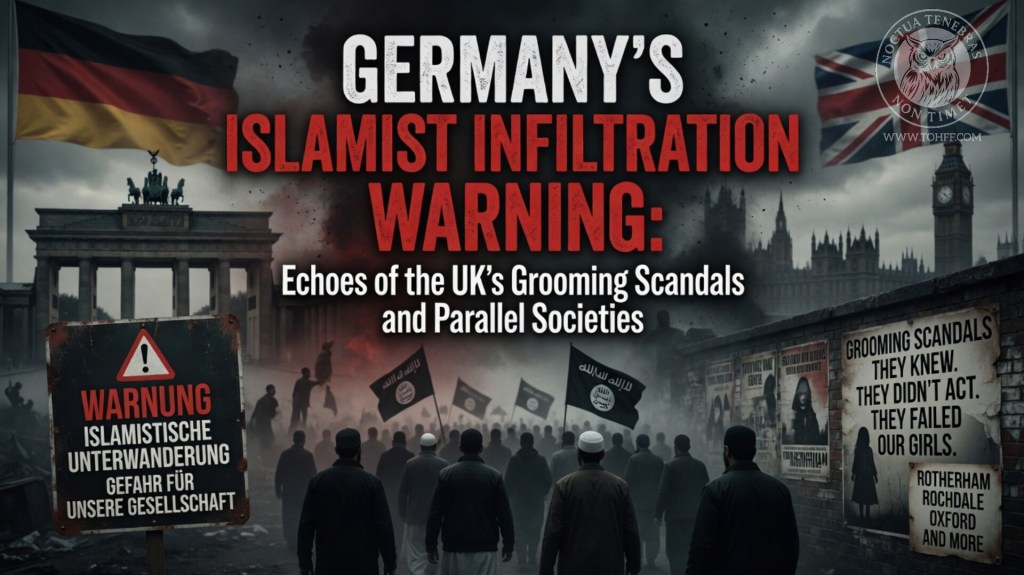
A leaked briefing from Germany’s domestic intelligence agency has sent ripples across Europe. In early June 2026, Bundesamt für Verfassungsschutz (BfV) President Sinan Selen warned parliamentarians in a closed-door Bundestag session that Islamist networks—particularly those linked to the Muslim Brotherhood—are pursuing a long-term strategy to “gradually transform” German social and political decision-making processes.
Unlike jihadist terrorism, this approach relies on patient, non-violent entryism: building influence inside institutions rather than attacking them from outside. The assessment highlights efforts in politics, public bodies, charities, education, and civil society. It arrives amid scrutiny of groups like Islamic Relief Germany over alleged Brotherhood ties and renewed questions about state partnerships with Islamist-linked organizations.
This is not an isolated alarm. Similar patterns of demographic concentration, institutional influence, and cultural friction have played out in the United Kingdom, most notoriously in the grooming gang scandals of Rotherham, Rochdale, and other towns. Understanding the German warning alongside Britain’s experience offers a clearer picture of the challenges facing open European societies.
The German Report and Its Context
The BfV is Germany’s equivalent of MI5, tasked with protecting the constitutional order from extremism. Sinan Selen, a Turkish-born counterterrorism expert appointed director general in October 2025, delivered the briefing. He emphasized that the Muslim Brotherhood and affiliated networks operate strategically over decades, not through immediate violence but by embedding in decision-making circles.
The goal, according to participants, is the eventual establishment of an Islamic society. Tactics include forging political contacts, societal influence operations, and creating resilient relationships within institutions. The Brotherhood does not act violently in this context, Selen noted, but pursues objectives with long-term precision that makes it no less dangerous.
This assessment builds on longstanding BfV concerns about “legalistic Islamism”—non-violent but ideologically driven efforts that create parallel milieus, especially through youth work, education, and community organizations. Earlier agency reports have flagged how such activities can undermine integration and social cohesion.
The leak to BILD amplified the story, sparking debate about transparency and the scale of the challenge. It also coincided with audits and expulsions involving Islamic Relief Deutschland, highlighting risks when public funds or legitimacy flow to organizations with documented personnel overlaps to Brotherhood networks.
Muslim Brotherhood Tactics: Entryism and Gradual Transformation
The Muslim Brotherhood, founded in Egypt in 1928, has long adapted its methods to different environments. In Europe, it favors a “civilizational” or gradualist approach rather than open confrontation. Core elements include the doctrine of tamkeen—institutional entrenchment—and the creation of front organizations that present a moderate, representative face while advancing Islamist goals.
Key tactics observed across Europe, including Germany:
- Front organizations and umbrella groups: Entities with names suggesting broad Muslim representation (e.g., cultural associations, youth groups, or human rights bodies) that mask Brotherhood links. These allow influence without easy attribution.
- Political and institutional entryism: Building relationships with parties, policymakers, and public bodies. This includes invitations to events, advisory roles, and positioning as go-to interlocutors on Muslim issues.
- Charity and welfare networks: Humanitarian work provides legitimacy, funding channels, and grassroots support. Scrutiny of groups like Islamic Relief illustrates how such platforms can overlap with ideological networks.
- Education and youth outreach: Islamic schools, study centers, and youth organizations shape the next generation’s worldview, sometimes promoting parallel values resistant to full secular integration.
- Narrative control: Framing criticism as “Islamophobia” to deter scrutiny, while using double discourse—moderate public statements alongside more radical internal or event-based messaging.
- Alliances and pragmatism: Tactical partnerships with progressive or left-leaning groups on shared issues (e.g., anti-racism campaigns) to gain influence and funding.
These methods exploit democratic freedoms—association, speech, and religion—while pursuing objectives that include Sharia-influenced norms in family and community matters. European security services have documented extensive networks operating through decentralized structures, rebranding, and cross-border coordination via bodies like the Council of European Muslims (formerly FIOE).
The approach is patient. It prioritizes legitimacy and incremental gains over headlines, making it harder for liberal democracies to respond decisively.
UK Parallels: Grooming Gangs, Demographics, and Influence
Britain offers a stark case study of what happens when similar dynamics intersect with rapid demographic change and institutional hesitation. The Rotherham scandal stands out. Between 1997 and 2013, an estimated 1,400 children—mostly White British girls—were sexually exploited by predominantly British-Pakistani men.
The Jay Report (2014) detailed appalling abuse: grooming, gang rape, trafficking, and intimidation. Victims were often from vulnerable backgrounds. Crucially, authorities—police, social services, and Rotherham Council—failed to act effectively for years. Factors included fear of racism accusations, concerns about damaging “community relations,” sexist attitudes toward victims, and a culture that downplayed or covered up issues.
Similar patterns emerged in Rochdale, Oxford, Telford, and elsewhere. Official inquiries confirmed systemic failures, with ethnicity data sometimes poorly recorded or avoided. While not every perpetrator was Muslim or linked to organized networks, the over-representation of Pakistani-heritage men in group-based child sexual exploitation cases in certain areas has been repeatedly documented. Political correctness and reluctance to confront cultural or religious factors played a documented role in the inaction.
Demographic shifts have compounded these issues. The 2021 census showed Muslims comprising 6.5% of England and Wales (up significantly), with heavy concentrations in cities like Birmingham, Bradford, and London boroughs such as Tower Hamlets and Newham. In some neighborhoods, this has led to parallel societies where integration is limited, Sharia-influenced practices emerge informally, and community leaders wield significant local influence.
Politically, Islamist-linked or sympathetic networks have gained footholds through voting blocs, council representation, and activism. Reports highlight influence in local government on issues ranging from foreign policy grievances to domestic accommodations. This mirrors the institutional entryism flagged in Germany—using democratic mechanisms to advance agendas that may conflict with liberal norms on gender, free speech, and secular governance.
Britain’s experience shows the human cost: failed safeguarding, betrayed victims, and eroded trust in institutions. It also demonstrates how mass low-skilled immigration from culturally distant regions, combined with ideological networks, can create enclaves resistant to assimilation.
Lessons and Implications
The German BfV warning and UK scandals share common threads: exploitation of openness, institutional capture through influence rather than force, and hesitation driven by fear of cultural conflict. Both highlight risks when multiculturalism prioritizes group identities over shared values and when authorities avoid “sensitive” topics.
Not all immigrants or Muslims are involved—many integrate successfully and contribute positively. The problems stem from specific ideologies (Islamism’s supremacist and gradualist strains), certain subgroups, and policy failures around integration, vetting, and enforcement.
Europe faces choices. Germany’s intelligence community is urging vigilance against slow transformation. Britain’s inquiries demand accountability and cultural honesty. Effective responses could include:
- Transparent monitoring of extremist networks without stigmatizing entire communities.
- Stricter due diligence on public funding and partnerships.
- Prioritizing assimilation and shared values in immigration and integration policy.
- Robust child protection that ignores political correctness.
- Addressing root causes like parallel societies through education, enforcement, and demographic realism.
Ignoring these patterns risks repeating past mistakes on a larger scale. The BfV briefing serves as a timely reminder that threats to liberal democracy can come from within—patiently, strategically, and under the radar.
Books on Amazon
Counter Terrorism: Terrorist Attack Response
This book highlights terrorist threats & how to respond to bombings, active shooter, knife and vehicle ramming attacks.
Audio Book @ https://www.amazon.com/dp/B0DYFBJTJQ
Kindle @ https://www.amazon.com/dp/B07BT479DZ
Paper Back @ https://www.amazon.com/dp/1980690456
Hard Cover @ https://www.amazon.com/dp/B0FKSRQ73G

