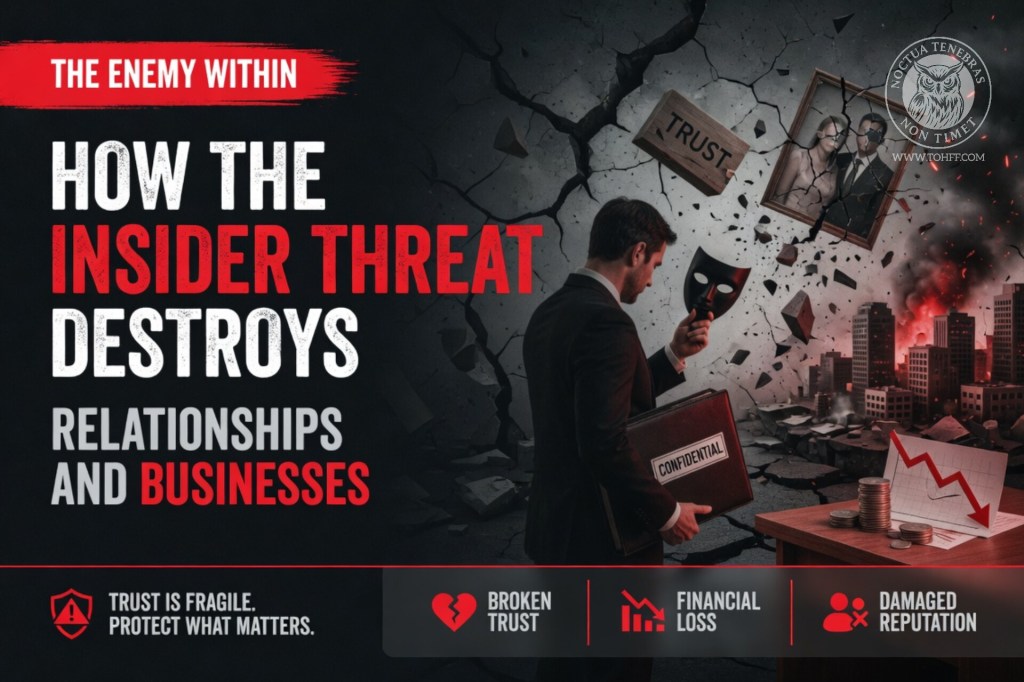
We often envision threats as coming from the outside: a masked intruder, a rival corporation, a hacker in a distant land. We fortify our castles with high walls, sophisticated alarms, and complex passwords, assuming that safety lies in keeping the “other” out. Yet, history and human experience teach us a painful lesson: the most devastating attacks often come from within. The “insider threat”—the risk posed by individuals who have intimate access to our lives or organizations—is a phenomenon that respects no boundaries, cutting a swath of destruction through both personal relationships and the corporate world.
The mechanics of the insider threat are remarkably similar, whether in a marriage or a multinational bank. It is fueled by access, intimate knowledge of vulnerabilities, and a catalyst—often a potent cocktail of emotion that turns a trusted ally into a bitter adversary. In our personal lives, this is the jealous partner or the betrayed friend who uses your secrets as weapons. In business, it is the disgruntled employee, the corporate spy, or the rogue trader. Understanding this dual nature of the threat is the first step in mitigating its devastating impact.
The Poison in the Garden: The Insider Threat to Personal Relationships
The foundation of any deep personal relationship is vulnerability. We share our fears, our passwords, our financial details, and our deepest insecurities with partners, family, and close friends. This sacred trust is the bedrock of human connection. When that trust is breached by an insider, it is not just an inconvenience; it is a profound existential shock that can unravel the very fabric of our lives.
Jealousy: The Green-Eyed Monster
Jealousy is arguably the most potent catalyst for the insider threat in personal life. It is the toxic byproduct of insecurity, fear of loss, and a perceived threat to a valued relationship. But jealousy is rarely a quiet, internal emotion. When it festers, it transforms into destructive behavior designed to control, monitor, or sabotage.
In the digital age, this often manifests as digital surveillance. A jealous partner might become an “insider” of your digital life, using shared knowledge of your passwords to read your emails, scan your text messages, or track your location via shared apps. This is a passive form of espionage, where information is gathered to fuel suspicion or to “catch” the other partner. The damage is immediate. Trust evaporates. The victim feels violated, stripped of privacy, and begins to walk on eggshells, inadvertently changing their behavior, which only deepens the suspicious partner’s paranoia. It creates a feedback loop of toxicity that is incredibly difficult to break.
In its active form, jealousy can lead to “information warfare” within a social circle. An insider, feeling wronged or abandoned, might weaponize shared secrets. They might spread rumors, disclose embarrassing stories to mutual friends, or even engage in “financial infidelity”—secretly spending joint savings as a form of retribution. The goal is to destabilize the target, to ensure that if they are unhappy, everyone else will be too. This type of insider attack isn’t about the target’s actions; it’s about the perpetrator’s perception of control and power.
The Complexity of a “Friendly” Insider
Another facet of the personal insider threat is the “friendly” insider who inadvertently exposes you to risk. Consider the friend who is a little too chatty on social media, posting photographs of your home, your expensive purchases, and your vacation schedule. They become a vector for an external threat, inadvertently providing a blueprint for a burglary. This is the insider threat born of negligence rather than malice, yet the consequences can be just as severe. They are an insider because they have access to your life, but they lack the awareness or discretion to protect that information.
When the personal insider threat erupts, the consequences are catastrophic. It is not a failure of a system, but a failure of a human connection. It results in shattered trust that can take years—if ever—to rebuild. It can lead to public humiliation, legal battles over custody and assets, and profound psychological damage to all involved, including children. The “breach” is deeply intimate, leaving a scar that is often invisible but always present. The threat is not just to the relationship itself, but to the individual’s sense of self, security, and fundamental faith in others.
The Bleeding Corporation: The Insider Threat to Businesses
If the personal insider threat destroys the individual, the corporate insider threat can destroy entire companies. It represents a “bleeding” from within, where the organization’s own trusted employees, contractors, or business partners become the primary source of its downfall. The costs are staggering, running into billions of dollars annually, not just in immediate financial loss, but in long-term reputational damage and legal liability.
The Spectrum of Malice and Negligence
The corporate insider threat exists on a broad spectrum. It’s not just about the malicious whistleblower or the corporate spy. The Cybersecurity and Infrastructure Security Agency (CISA) categorizes these threats into three main types, which apply universally to businesses:
- The Malicious Insider: This is the most visible type. This individual intentionally uses their authorized access to harm the organization. Their motives are varied: financial gain (selling trade secrets), revenge (a disgruntled employee), or ideology (a whistleblower or activist). They are deliberate actors who plan and execute their attacks.
- The Negligent Insider: This is perhaps the most common and equally dangerous threat. This is the well-meaning employee who makes a mistake. They click on a phishing link, leave a laptop in a coffee shop, use a weak password, or send sensitive data to the wrong person. They pose a threat through carelessness, a lack of security awareness, or a belief that “it won’t happen to me.” They are the unwitting accomplices in the company’s own downfall.
- The Compromised Insider: This is the unsuspecting victim. Their credentials, such as their username and password, have been stolen by an external threat actor. The hacker is now using the insider’s legitimate access to move through the network undetected. The employee’s access is the “keys to the kingdom,” and they don’t even know they’ve been pickpocketed.
Insider Trading: The Quintessential Financial Threat
One of the most high-profile and damaging forms of the malicious insider threat is insider trading. At its core, it’s a profound abuse of trust and a violation of fiduciary duty. An insider, such as an executive, a board member, or an employee in a sensitive department, possesses material, non-public information. This could be knowledge of an impending merger, a massive financial loss, or a breakthrough product.
When that individual uses this privileged knowledge to buy or sell stock—or tips off a friend or family member so they can do the same—it undermines the very integrity of the financial markets. It erodes public confidence, destroys shareholder value, and creates an uneven playing field where the few profit at the expense of the many. The consequences for the individual are severe: massive fines, imprisonment, and a lifetime ban from corporate leadership. The fallout for the company can be just as devastating. The news of an investigation can send stock prices plummeting, trigger class-action lawsuits from shareholders, and severely damage the company’s reputation, making it a pariah in the business community.
Intellectual Property Theft and Espionage
Beyond financial trading, businesses are threatened by the theft of their “crown jewels”: their intellectual property (IP). In a knowledge-based economy, IP is often a company’s most valuable asset. A malicious insider can systematically download thousands of files containing source code, proprietary formulas, client lists, or strategic plans. They might do this to sell to a competitor, start a rival business, or use it as leverage in a negotiation.
Corporate espionage takes this a step further. This often involves an insider who has been specifically recruited by a competitor or a foreign government. Their job is to embed themselves and gradually leak information over a long period. The “insider” in this case might be a new hire whose main qualification was the access they would provide, or a long-standing employee who is being blackmailed or bribed. This is a slow-moving, silent heist that can drain a company’s competitive advantage before anyone even knows something is wrong.
The impact of a corporate insider threat is a chain reaction. First, there is the immediate financial loss (the cost of the stolen funds or the value of the IP). Then, the cost of the investigation, the inevitable lawsuits, and the regulatory fines. Then, the massive cost of remediation—upgrading security systems, re-issuing credentials, and hiring crisis management teams. Finally, and perhaps most devastatingly, is the loss of reputation. A company that cannot protect itself or its clients’ data will be seen as untrustworthy, leading to a loss of customers, investors, and a decline in employee morale.
The Common Thread: The Human Element
When we peel back the layers of the insider threat, whether in a family or a Fortune 500 company, we find a common denominator: the human element. The breach almost always begins with a human emotion or failing.
- · Sense of Entitlement: In a business, an employee might feel underpaid and undervalued, justifying their theft as “getting what they’re owed.” In a relationship, a partner might feel entitled to monitor their spouse’s communications because they “provide for them.”
- · Disgruntlement and Revenge: A passed-over promotion can lead an employee to sabotage a project. A perceived slight or a broken heart can lead a personal insider to spread malicious rumors. The desire for revenge is a powerful motivator in both arenas.
- · Desperation and Financial Pressure: An employee drowning in debt or a partner with a secret gambling addiction can be easily tempted to use their inside access for financial gain.
- · Negligence and Complacency: In both personal and professional life, the threat is often ignored until it’s too late. We are complacent about the security of our own data and the vigilance of those around us.
Mitigating the Threat: A Dual Approach
Protecting against the insider threat requires a dual approach that mirrors the duality of the threat itself: we must secure the technical systems and the human systems.
For Personal Life:
- · Acknowledge Vulnerability: Recognize that the people you trust can hurt you. This isn’t about paranoia; it’s about practical awareness. Don’t share passwords lightly and be mindful of what you share on social media.
- · Secure Your Digital Life: Use strong, unique passwords and enable two-factor authentication for critical accounts. Have a private, secure vault for sensitive documents.
- · Foster Open Communication: The best defense against jealousy and misunderstanding is often honest, difficult conversations. Address insecurities before they fester into destructive behaviors.
- · Professional Intervention: If trust has been severely breached, don’t hesitate to seek the help of a counselor or therapist. Sometimes, a neutral third party is needed to rebuild or gracefully end the relationship.
For Businesses:
- · Build a Culture of Security: Security is not just the IT department’s job; it’s everyone’s responsibility. Regular, engaging training on phishing and data-handling policies is crucial. Create a culture where employees feel safe reporting mistakes or suspicious behavior without fear of immediate retribution.
- · Principle of Least Privilege: Employees should only have access to the data and systems they need to do their jobs. This minimizes the potential damage of any single compromised account.
- · Monitor User Behavior: Implement systems to detect anomalies—a sudden download of thousands of files, a log-in at an unusual time, or an email to an external address containing sensitive keywords.
- · Manage the Offboarding Process: This is a critical point of vulnerability. When an employee leaves (voluntarily or involuntarily), their access must be revoked immediately to prevent them from taking data with them.
- · Support and Engage Employees: A happy, valued, and fairly compensated employee is far less likely to turn malicious. Invest in employee well-being and create clear, internal channels for reporting grievances before they escalate into threats.
Conclusion
The insider threat is a stark reminder that vulnerability is an inherent part of connection, whether we are building a life with a partner or a corporation with a team. We cannot protect ourselves by building higher walls and isolating ourselves. Instead, we must acknowledge the risk, understand the psychology of those who turn against us, and build resilience on both a personal and organizational level. By recognizing that the “enemy within” is often born of jealousy, greed, anger, or simple carelessness, we can take proactive steps to secure our secrets, foster trust, and protect what we have built. The goal is not to eliminate risk—that is impossible—but to manage it, so that when trust is betrayed, the damage is contained, and we can begin to heal and rebuild.
Books on Amazon
Social Navigation
A Practical Survival Guide For Human Interactions
In this book I’m sharing some of my experiences, in addition to giving you hard love advice on how to deal with those who you encounter.
Audio Book @ https://www.amazon.com/dp/B0FDL1CBL3
Kindle @ https://www.amazon.com/dp/B0C4FTBS42
Paper Back @ https://www.amazon.com/dp/B0C47JD1BZ
Hard Cover @ https://www.amazon.com/dp/B0FKGQVNH7

