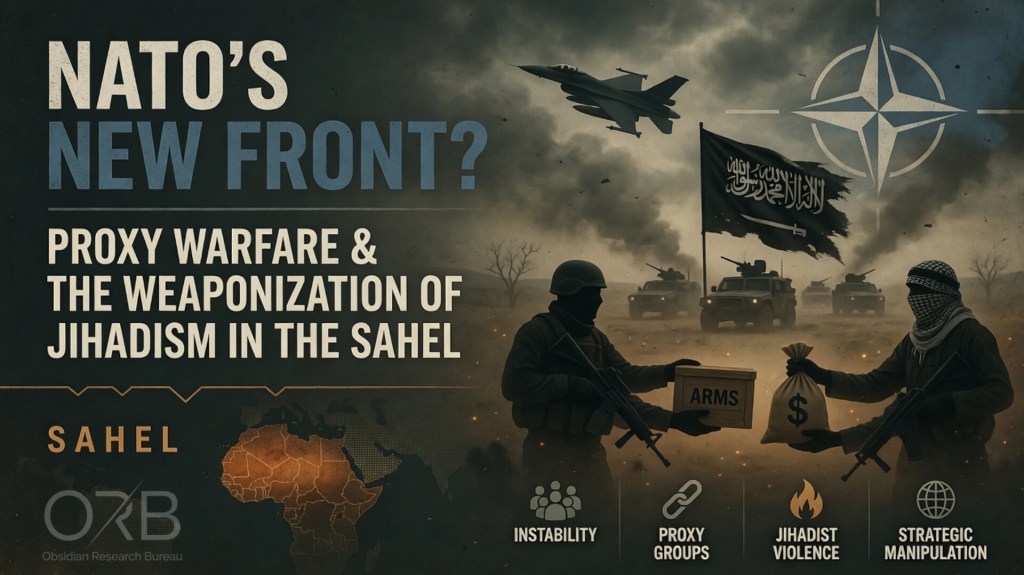
The Sahel region has emerged as the global epicenter of terrorism, accounting for over half of all terrorism-related deaths worldwide in 2025. At the heart of this crisis stands Jama’at Nusrat al-Islam wal-Muslimin (JNIM), the Al-Qaeda-aligned coalition that has evolved from a regional insurgency into a sophisticated hybrid threat capable of cross-border drone warfare and economic blockade operations. However, the JNIM phenomenon cannot be understood solely through the lens of Salafi-jihadist ideology or local grievances. The group has increasingly become enmeshed in a complex web of geopolitical competition, where great powers and regional actors leverage extremist and separatist forces as instruments of proxy warfare—a pattern that echoes earlier conflicts in Syria, Libya, and elsewhere.
The Logic of Proxy Warfare in the Sahel
Ordinarily in geopolitics, it is not uncommon to find actors cooperating with the enemy of their enemies to gain an upper hand in conflicts . However, the Sahel presents a uniquely complex dynamic in which three distinct groups of actors—Western powers, Russian-backed juntas, and terror groups—find themselves in a triangular competition where the enemy of one’s enemy is not necessarily a friend . In this environment, the lines between state interests, ideological objectives, and tactical convenience have become dangerously blurred, with non-state actors serving as convenient instruments for external powers seeking to advance their strategic agendas without committing to direct military engagement.
The Sahel’s strategic importance—as a transit corridor between North and Sub-Saharan Africa, as a source of critical minerals including uranium and gold, and as a theater for competing geopolitical visions—has transformed it into a proving ground for proxy warfare . France, the former colonial power, has sought to maintain influence through military interventions like Operation Serval and Operation Barkhane, though its position has been severely weakened by anti-French sentiment and military coups in Mali, Burkina Faso, and Niger . Russia, through the Wagner Group and subsequently the Africa Corps, has aggressively moved to fill the security vacuum, offering military support to Sahelian juntas in exchange for access to natural resources and geopolitical leverage . Ukraine, locked in its own existential conflict with Russia, has sought to open a “second front” in Africa by supporting groups aligned against Russian interests . Meanwhile, Turkey has pursued its own influence through proxy groups, including Islamist forces in Syria .
The Historical Precedent: NATO and Extremist Groups
The current use of extremist groups as proxies in the Sahel is not without historical precedent. During the Syrian civil war, a complex constellation of actors—including the United States, Britain, France, Turkey, Saudi Arabia, and Qatar—provided support to opposition forces that included Islamist and jihadist elements . The Free Syrian Army, dominated by the Syrian Muslim Brotherhood, coordinated closely with foreign jihadist groups, including the Al-Nusra Front, which was not placed on the US terrorist blacklist for months precisely because it was “in effect a key ally in the war against Syria” . Turkey, a NATO member, used Islamic nationalist and Takfiri groups including HTS (Syrian Al-Qaeda) and known members of Daesh during its illegal invasion and subsequent occupation of Syrian and Iraqi territory . Turkish and Turkish-backed forces targeted positions where US and other NATO troops were visibly present, creating dangerous situations for alliance cohesion .
In Libya, NATO intervention in 2011 similarly created conditions where jihadist groups could flourish, with the collapse of the Qaddafi regime opening vast arms depots that eventually supplied groups across the Sahel . The Arab uprisings of 2011 marked a turning point where external state support no longer adhered to the historic East versus West bloc system, opening the possibility of allies forming constellations where they could back forces on opposite sides . This pattern of opportunistic alliance with extremist elements—often justified through the language of humanitarian intervention or counterterrorism—has established a dangerous precedent that is now being replicated in the Sahel.
Ukraine’s Proxy Engagement: The Anti-Russia Dimension
The most dramatic manifestation of proxy dynamics in the Sahel has been the involvement of Ukrainian intelligence in supporting forces arrayed against Russian interests. Mali formally accused Ukraine of directly supporting Tuareg rebels in the country’s north, providing intelligence, logistical support, and military technology training to armed groups . The Malian military discovered Ukrainian-manufactured FPV drones and documents linked to Ukraine’s Main Intelligence Directorate (GUR) abandoned by militants during a counter-offensive .
What makes this particularly significant—and troubling—is the relationship between these supported groups and JNIM. Ukrainian intelligence has primarily supported the secular Tuareg separatist movement, the Azawad Liberation Front (FLA) . However, the FLA has forged a de facto operational alliance with JNIM, with the two groups conducting coordinated attacks on Malian forces in April 2026 and sharing tactics and equipment . This has created a concerning situation where Ukrainian support for separatist forces indirectly benefits the Al-Qaeda-affiliated JNIM through technical diffusion and joint operations .
The Ukrainian military intelligence spokesman, Andriy Yusov, publicly stated that Tuareg rebels who ambushed Russian personnel in Mali “received necessary information, and not just information, which allowed them to carry out a successful military operation,” adding that cooperation would “continue” and Russian forces would be “punished wherever they are in the world” . This admission, combined with reports of approximately twenty Ukrainian advisors in northern Mali training armed groups in drone use and combat techniques, indicates a deliberate strategy of using proxy forces to degrade Russian influence in Africa .
The stated justification—countering Russian aggression in the context of the Ukraine war—represents a significant expansion of conflict geography. Russia supports the Sahelian juntas, and Ukraine counters by supporting their opponents, regardless of whether those opponents are secular separatists or Al-Qaeda affiliates. The risk of “technical assistance spillover” has been explicitly noted by observers who worry that the transfer of Ukrainian drone technology and training to the FLA could eventually benefit JNIM, particularly given the two groups’ operational cooperation .
France’s Ambiguous Position
France’s role in the Sahel has been characterized by a combination of genuine counterterrorism operations and the pursuit of strategic interests, including securing access to uranium and maintaining political hegemony rooted in its former colonial status . However, France’s efforts have been hampered by the rise of anti-Western sentiment and its inability to address the underlying local networks, ethnic bases, and socioeconomic grievances that sustain groups like JNIM .
The junta-led governments in Mali, Burkina Faso, and Niger have aggressively expelled French forces, turning to Russia instead . However, allegations continue to surface regarding French covert activities in the region. Niger’s military leader, General Abdourahamane Tiani, publicly accused France of “pushing and financing the authors” of a recent attack on Niamey airport, claiming that French intelligence and special forces had flooded mercenaries with weapons and equipment since April 2025 in the Liptako-Gourma region . Tiani further alleged that France provided 300 million CFA francs (approximately $542,000) to armed groups, including JNIM and the Islamic State in the Greater Sahara (ISGS), to conduct operations .
Whether these allegations are accurate or serve as convenient narratives for the junta to justify their anti-French posture, they reflect the reality of a region where every major power is accused of supporting extremist groups for their own ends. The perception that Western powers might be willing to tolerate or even encourage jihadist activity to undermine rival powers—Russia, China, or regional governments—has created an environment of profound mistrust .
Russia: Fighting Terror While Supporting Authoritarianism
Russia’s involvement in the Sahel through the Wagner Group and Africa Corps has been driven by a combination of economic interests, strategic positioning, and the desire to counter Western influence . In Mali, Wagner personnel were paid $10.8 million monthly and granted mining concessions in exchange for providing security and training to the junta . Russian engagement has been framed as a counterterrorism mission, with the Africa Corps actively working to secure supply routes and prevent JNIM from cutting off fuel supplies to Bamako .
However, Russian actions have been heavily criticized for their brutality and ineffectiveness. Between January and October 2024, Malian military and allied Wagner forces killed approximately 1,063 civilians, creating grievances that JNIM actively exploits for recruitment . The rebranding of Wagner as the Africa Corps—a name evoking the Nazi-era Afrika Korps—has not changed the fundamental reality that Russian forces are unable to fully support the Malian military against JNIM .
Russia’s strategy faces a fundamental contradiction: it cannot both support authoritarian junta and effectively fight a counterinsurgency that requires winning hearts and minds. The Wagner-Africa Corps experience in Mali has been described as a failure, with the group suffering significant losses, withdrawing from the country, and leaving much of the actual fighting to African mercenaries .
The Three-Way Competition: A New Cold War?
The current configuration in the Sahel represents a three-way competition between Western allies, Russian-backed juntas, and terrorist groups . Western states are focused on cooperating with coastal states through frameworks like the Accra Initiative, aiming to prevent the southward spread of terrorism . Juntas and their Russian allies are fighting terrorist groups, though often counterproductively. Terror groups, despite their internal differences, are hostile to both Western interests and Russian-backed juntas .
What makes this situation particularly dangerous is the absence of the “enemy of my enemy” logic that typically drives proxy dynamics. In the Sahel, the three groups are “enemies” to each other in a triangular competition where cooperation across state and non-state lines remains unpredictable . Western states oppose both Russian-backed juntas and terror groups; the juntas and their Russian allies also oppose terror groups but have moved against Western interests; and terror groups are against both Western interests and the Russian-backed juntas .
This triangular dynamic creates perverse incentives. A Western state seeking to counter Russian influence might be tempted to turn a blind eye to JNIM operations that degrade Russian positions. A Russian-backed junta might prioritize attacks on its domestic political enemies over counterterrorism. A terrorist group like JNIM might accept covert support from a state actor to weaken a common enemy, even if that state actor is ideologically opposed to the group’s objectives.
JNIM’s Exploitation of Proxy Dynamics
JNIM has demonstrated an impressive capacity to exploit the proxy dynamics that surround it. The group’s strategic expansion from Mali into Burkina Faso, Niger, and coastal West Africa has been facilitated by the security vacuum created by the French withdrawal and Russia’s inability to provide effective security . JNIM has integrated local grievances—ethnic marginalization, economic exclusion, state abuse—into its narrative of resistance, making it difficult for external powers to counter without addressing these root causes .
JNIM has also benefited from the technical diffusion enabled by proxy support. Ukrainian-supplied FPV drone technology intended for Tuareg separatists has reportedly found its way to JNIM-affiliated forces . JNIM’s propaganda apparatus has masterfully framed the group as a legitimate resistance movement defending marginalized populations against corrupt, foreign-backed governments . The group has even opened channels on platforms like TikTok to debate civilians, justify its rule, and promote its implementation of Sharia law, indicating a sophisticated understanding of modern communications .
Conclusion: The Need for Strategic Clarity
JNIM is not simply a Salafi-jihadist terrorist group; it is a product of the geopolitical fragmentation and proxy warfare that have consumed the Sahel. The group has been shaped by—and has exploited—the competing agendas of France, Russia, Ukraine, Turkey, and regional powers, each of which has, at various points, seen value in supporting or tolerating extremist forces to advance their own interests.
The pattern of state support for extremist proxies, established in Syria and Libya, has now come to the Sahel. As the cases of Ukraine, France, and others demonstrate, counterterrorism is often subordinated to geopolitical competition. This has created a situation where the “fight against terrorism” is little more than a smokescreen for power projection, with jihadist groups like JNIM being the ultimate beneficiaries.
Addressing the JNIM threat requires a recognition that military solutions alone are insufficient and that counterterrorism cannot be decoupled from the broader geopolitical dynamics that sustain the conflict. Without addressing the proxy dynamics that enable JNIM to thrive—through technical support, strategic toleration, or the creation of security vacuums—counterterrorism efforts will remain merely reactive. The Sahel has become the global epicenter of terrorism not despite great power competition, but in large part because of it.
Book on Amazon!
Intelligence Gathering: Front Line HUMINT Considerations
The things I talk about in this book are double-sided; can be used to
target others or used against you.
Audio Book @ https://www.amazon.com/dp/B0DJMW8SM5
Kindle @ https://www.amazon.com/dp/B086WPL4XS
Paper Back @ https://www.amazon.com/dp/B086PN2KLQ
Hard Cover @ https://www.amazon.com/dp/B0FK25TC7D

