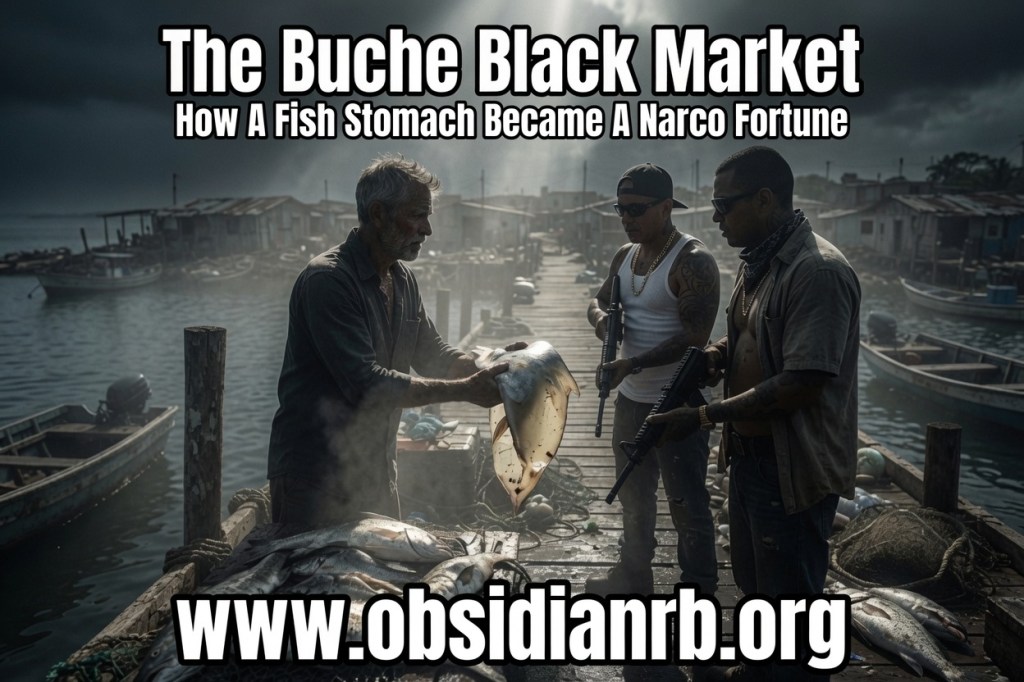
We received reports over a decade ago on the little known trade of the guts of the corvina fish between Narcos and fisherman. It’s an interesting side business of the Narco industry that has developed due to necessity and innovation, that can reap big profits for trading fish guts…
In the perpetual cat-and-mouse game between international drug cartels and law enforcement, the most unsettling innovations are often those that twist the natural world into a tool for narco-trafficking. We are witnessing a disturbing evolution in the methodology of the “mule,” one that moves away from crude synthetic engineering and towards biological mimicry. The commercialization of the corvina fish’s gastrointestinal tract represents a pivotal and macabre shift in this dynamic. This is not merely a new hiding method; it is a highly specialized physiological solution to a logistical problem that was previously bleeding the cartels of both personnel and product. The transition from latex to biological matter—specifically the guts of the corvina—signifies a calculated, if grotesque, corporate-level efficiency drive within the underworld.
The Latex Catastrophe: A Legacy of Lethal Failure
To understand the premium value of the corvina gut, one must first comprehend the catastrophic failure rate of its predecessor: the latex capsule. For decades, “swallowers” were equipped with pellets, condoms, or surgical gloves filled with cocaine or heroin. The technique was low-tech and high-risk, predicated on the assumption that a material designed for household or medical use could withstand the violent chemical environment of the human stomach.
The human gastric system is not a static storage pouch; it is an active, churning, highly acidic crucible. The pH level in a stomach can drop to 1.5, powerful enough to dissolve metal. When a mule swallowed multiple latex packages, the material was subjected to constant mechanical friction (peristalsis) and a chemical onslaught. Latex is a natural polymer derived from rubber, and while flexible, it is extremely vulnerable to lipids and acidic hydrolysis. Gastric juices do not simply slide off latex; they initiate a degradation process. The lipids in the stomach emulsify the structural integrity of the latex, weakening the membrane walls. Simultaneously, the hydrochloric acid attacks the polymer chains. This dual action creates a ticking time bomb.
The result was often a “wet pop”—a term used by traffickers to describe an internal rupture. When a latex capsule containing liquid cocaine or a powdered alkaloid solution bursts inside the stomach, the outcome is almost invariably fatal. The victim does not die from the drug crossing the blood-brain barrier slowly; they die from a massive, acute overdose as the entire payload of pure, non-liver-metabolized substance hits the gastric lining instantly. This triggers immediate cardiotoxicity or neurotoxic shutdown, often before the mule can even signal for help. For the cartels, this represented a cold, calculated “shrinkage” problem. The financial loss was not just the street value of the cocaine, but the sunk logistics cost of moving the mule across borders, coupled with the heightened law enforcement scrutiny that follows a sudden death in an airport customs line. The cartels needed an inert, biological container that could coexist with the stomach rather than fight it.
The Corvina Solution: Selective Breeding of a Container
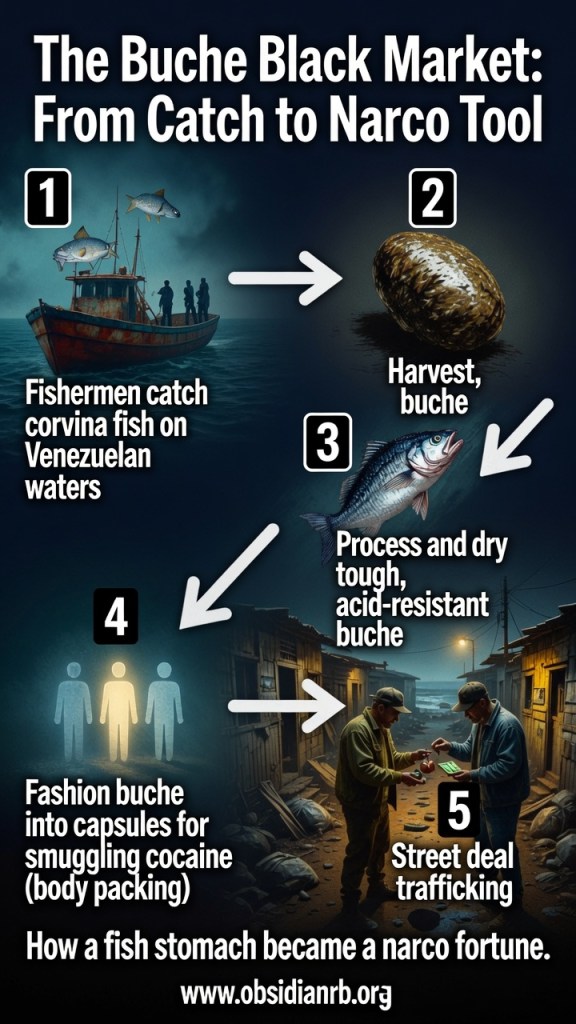
The answer was found in the digestive system of the corvina, specifically the “buche” or swim bladder/gas bladder, which is often confused in street parlance with the actual stomach lining, though both exhibit the desired properties. The corvina, a robust predatory fish found in the warmer waters of the Gulf of Mexico and the Pacific, relies on a digestive system tough enough to process spiny-finned prey, crustacean shells, and hard baitfish. Evolution has gifted this species with a gastrointestinal tract that is not just a membrane, but a biomechanical barrier.
The primary advantage of the corvina gut—typically the dried, treated stomach or swim bladder—is its extraordinary resistance to acid and enzymatic corrosion. Unlike latex, which is a foreign petrochemical-derived substance, the fish gut is collagen-based protein. It has an innate biocompatibility. The gastric juices of the human stomach do not read this tissue as a synthetic invader to be attacked; they read it as a dense piece of food protein that requires extremely slow digestion. The density of the collagen matrix in the corvina gut means that even potent pepsin enzymes and hydrochloric acid take a significantly longer time to break through the wall.
Furthermore, the structural design is superior to any rolled latex. The corvina gut is a natural tube, which allows traffickers to tie it off into seamless, streamlined capsules. There are no sharp edges, no friction-welded seams that might split under pressure. It possesses a viscoelastic flexibility, meaning it can bend and undulate with the stomach’s muscular contractions without kinking or tearing. This flexibility also facilitates swallowing; the lubricated, slimy texture of the rehydrated fish gut mimics the texture of food bolus, gliding down the esophagus with far less risk of the choking hazard that rigid latex packs present.
The third critical advantage is the barrier protection from contamination. Latex is microporous, and over time, gastric fluids can seep inward, degrading the drug and ruining its color and consistency, making it unsellable. The dense protein structure of the corvina gut is hermetic when properly prepared. It prevents the stomach acid from turning the pristine white powder inside into a yellowish, sour-smelling paste. The product arrives looking “off the brick,” maximizing its value upon extraction.
The Underwater Economy of Violence
This biological solution has spawned a lucrative and deeply violent parallel economy centered on the viscera of a fish. The phrase “the kilo of these guts are very expensive” understates the reality. We are seeing the commodification of a biological waste product into a high-value tactical asset. The processing of corvina guts is a cottage industry that has rapidly scaled into a narco-industrial complex. Fishermen, once catching corvina for filets sold at market price, can now earn exponentially more by preserving and selling the offal to criminal brokers.
This has created a gold-rush economy in coastal fishing villages, but with the cartel’s signature brutality attached. The raw fish guts must be cleaned, disinfected, scraped of mucosa, stretched, and cured. The process requires a network of harvesters, processors, and quality control. A shipment of poorly cured guts that tears inside a mule is a multi-million-dollar loss. Consequently, cartels have moved to monopolize the supply chain.
The report’s mention of “multiple gun fights and killings between rival gangs” is not hyperbolic; it is the expected economic outcome of a zero-sum resource war. Unlike synthetic drug production, which can be scaled indefinitely in a laboratory, the supply of high-quality corvina guts is constrained by the fish’s biology and reproductive cycles. You cannot speed-breed a wild fish overnight. A kilo of dried, tractable corvina gut suitable for smuggling multiple grams of cocaine is a finite resource. Control over the estuaries and processing plants where these fish are gutted is now a strategic military objective for the cartels. They are fighting for the “panga” (boat) routes not just to move drugs, but to move fish offal.
Forensic Implications and Conclusion
This shift poses a profound challenge for medical imaging and law enforcement. X-ray detection of swallowed drug pellets has always relied on the density differential of latex wrapped around organic powder. A dried fish gut, rehydrated in the stomach, possesses a radiological density almost identical to the surrounding stomach tissue and food matter. It does not show the classic “halo” sign of air trapped between layers of latex, nor the distinct geometric shapes of machine-sealed condoms. On a CT scan, a corvina gut capsule can look indistinguishable from a ball of undigested rice or fibrous vegetable matter. The criminals have not just changed the material; they have blurred the line between the contraband and the human body itself. The creativity of these criminals is thus a dark form of applied biology, turning the sea’s indifference to acidity into a deadly instrument of the drug trade, writing a new chapter in forensic science where the evidence is designed to digest as slowly as a heavy meal.
Book on Amazon
Intelligence Gathering: Front Line HUMINT Considerations
The things I talk about in this book are double-sided; can be used to
target others or used against you.
Audio Book @ https://www.amazon.com/dp/B0DJMW8SM5
Kindle @ https://www.amazon.com/dp/B086WPL4XS
Paper Back @ https://www.amazon.com/dp/B086PN2KLQ
Hard Cover @ https://www.amazon.com/dp/B0FK25TC7D

