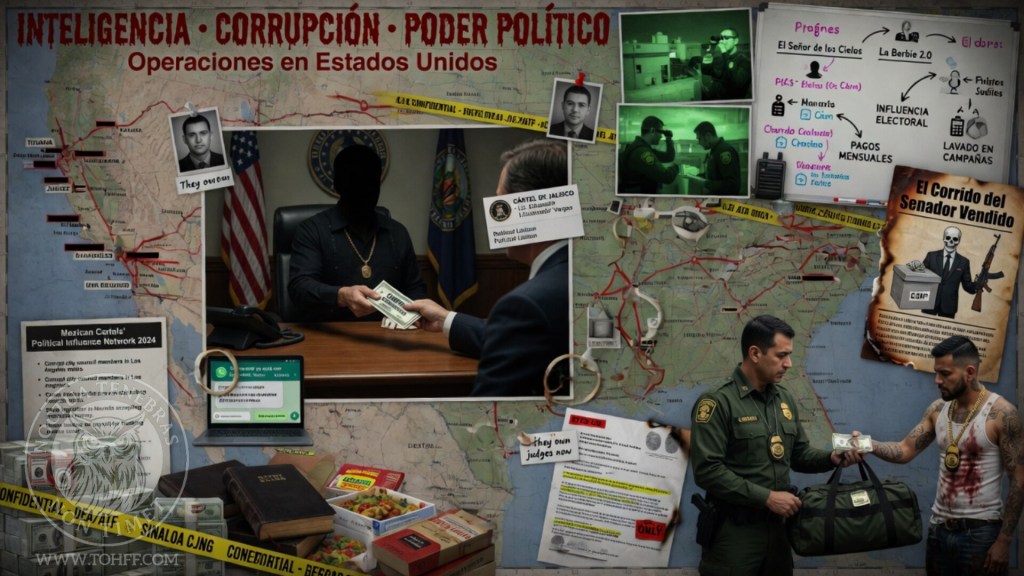
Mexican drug cartels, primarily the Sinaloa Cartel and the Jalisco New Generation Cartel (CJNG), represent one of the most significant transnational criminal threats to the United States. These organizations dominate the trafficking of fentanyl, methamphetamine, cocaine, heroin, and other drugs, fueling the U.S. opioid crisis that has claimed hundreds of thousands of American lives. While their core power base remains in Mexico, they maintain sophisticated networks across nearly all 50 U.S. states, operating through distribution cells, money laundering schemes, and adaptive smuggling strategies.
Their activities in the U.S. emphasize operational security, profit maximization, and evasion of law enforcement rather than overt violence or large-scale territorial control seen in Mexico. Intelligence operations, targeted corruption of officials, and indirect influence on U.S. politics form the pillars of their strategy. Public information derives from DEA reports, DOJ indictments, congressional testimony, and DHS investigations, though much operational detail remains classified.
Intelligence Operations in the United States
Cartels deploy intelligence capabilities that rival some state actors in focus and adaptability, centered on human intelligence (HUMINT), counter-surveillance, and real-time operational support for trafficking. Sinaloa maintains the broadest U.S. footprint, dominant along the West Coast, Midwest, and Northeast, while CJNG expands aggressively, particularly in fentanyl distribution.
HUMINT networks form the foundation. Cartels cultivate informants within transportation, logistics, telecommunications, and border-related industries. These sources provide details on U.S. Customs and Border Protection (CBP) procedures, personnel rotations, drug-detection technologies, and law enforcement tactics. This enables “shotgunning” tactics—flooding ports of entry with multiple vehicles to overwhelm inspections—and rapid adaptation to interdiction efforts.
Operatives embedded in U.S. cells conduct background checks, monitor rivals, and gather data on DEA and FBI activities. High-profile examples include CJNG surveillance of DEA agents and informants during trials, such as that of “El Menchito” (Rubén Oseguera González). Cartel members have reportedly shadowed agents in Washington, D.C., and Southern California, sometimes requiring local police intervention.
Deception plays a key role. Sinaloa lieutenants have posed as informants to U.S. agencies, feeding disinformation to undermine rivals like the Tijuana Cartel and consolidate territory. Cartels exploit agencies’ incentives to develop sources, sometimes providing genuine but limited intelligence while advancing their agendas.
Technological elements supplement HUMINT. Drones monitor border patrols and smuggling routes. Encrypted communications and countersurveillance protect U.S.-based distribution networks. While cyber capabilities are more developed in Mexico (e.g., phone tracking), the pattern indicates growing sophistication applicable to U.S. operations.
Cartels maintain presence in hundreds to over 1,000 U.S. cities, handling wholesale distribution, local security, and laundering. Cells collaborate with U.S. street gangs, prison gangs, and other transnational groups. This decentralized yet coordinated structure allows resilience against arrests. DEA assessments confirm operations in nearly every state, with violence mostly contained to retail-level disputes rather than cartel-on-cartel warfare on U.S. soil.
These intelligence efforts treat the U.S. as a business environment: low-profile, high-profit, and focused on supply chain integrity amid multi-billion-dollar revenues.
Corruption of U.S. Officials
Corruption serves as a critical enabler for penetrating U.S. borders and protecting operations. Unlike Mexico, where cartels have deeply infiltrated politics and police, U.S. corruption targets operational personnel with direct access—primarily CBP officers, Border Patrol agents, and occasionally local or federal officials. Stronger institutions, higher salaries, vetting, and oversight limit scale, but vulnerabilities persist.
Primary tactics include cash bribes, sexual favors (”honey traps”), and exploitation of personal weaknesses like debt or family ties. Bribes facilitate waving through drug- or migrant-laden vehicles, leaking raid information, or providing escorts. Newer agents (0-5 years of service) are statistically more vulnerable, often due to financial pressures. Some applicants are reportedly pre-recruited by cartel associates.
Historical data shows over 100-150 CBP/Border Patrol corruption arrests or indictments in peak periods (2004-2010s), with drug smuggling facilitation common. Recent cases include CBP officers in San Diego accepting bribes for methamphetamine loads and unauthorized immigrants. One officer was sentenced to 23 years for allowing vehicles through specific lanes.
Sexual recruitment appears alongside cash in DHS Inspector General findings. Threats or intimidation occur but are secondary to monetary incentives, given enormous cartel profits. Interior cases involve local sheriffs or officers in drug schemes, though these are aggressively prosecuted.
DEA corruption is rarer but impactful. Cases include agents stealing seized drugs, money laundering for cartels, or leaking information. A retired senior DEA official faced indictment for allegedly laundering millions for CJNG.
Countermeasures include polygraphs, periodic reinvestigations, financial monitoring, internal affairs units, and FBI/ICE task forces. Corruption represents a small fraction of the large CBP workforce but enables significant trafficking volumes. Each compromised official undermines border integrity and endangers colleagues.
Cartels view this as a routine business cost, funded by fentanyl and other drug revenues. Their HUMINT networks identify and cultivate targets systematically.
Influence on U.S. Politics
Direct cartel involvement in U.S. politics—such as campaign funding or control of elected officials—remains rare and largely unproven in public records. Federal laws prohibit foreign contributions, and robust oversight deters high-level infiltration. Cartels prioritize tactical corruption over strategic political capture in the U.S.
Instead, their influence is predominantly indirect and profound through the fentanyl crisis. Cartel-produced synthetic opioids drive overdose deaths, shaping voter priorities, congressional debates, and administration policies on border security, immigration, tariffs, and law enforcement. This has elevated cartel issues in elections, prompting designations as Foreign Terrorist Organizations (FTOs), sanctions, and calls for military options.
Money laundering through U.S. real estate, businesses, and banks occurs for profit concealment, not overt political control. Occasional local corruption (e.g., sheriffs) exists but does not indicate systemic political dominance.
On the Mexican side, cartels exert massive influence via bribes, assassinations, and vote-buying, affecting governors, mayors, and police. This spillover complicates U.S.-Mexico relations, trade (USMCA), and security cooperation (e.g., Mérida Initiative successors). U.S. indictments target corrupt Mexican officials with cartel ties.
U.S. responses include intelligence sharing, leadership targeting, vetted units, and bilateral initiatives like Project Portero. Challenges persist due to Mexican sovereignty concerns, corruption south of the border, and cartel adaptability. Recent arrests (e.g., “El Mayo” Zambada, factional infighting in Sinaloa, operations against CJNG’s “El Mencho”) highlight ongoing disruption efforts.
Implications and Outlook
Mexican cartels’ U.S. operations blend intelligence sophistication, opportunistic corruption, and indirect political pressure into a resilient business model. Their success stems from U.S. demand for drugs, vast profits, and Mexico’s governance gaps. The fentanyl epidemic remains their most devastating impact, turning a criminal enterprise into a national security and public health crisis.
U.S. agencies (DEA, FBI, DHS) continue dismantling networks through arrests, seizures, and international cooperation. However, fragmentation (e.g., Sinaloa infighting) can lead to short-term violence spikes or shifts to CJNG dominance, complicating efforts. Long-term success requires addressing demand, enhancing border technology, disrupting precursor chemicals from Asia, and strengthening bilateral trust despite political sensitivities.
In summary, while cartels lack the overt political control seen in Mexico, their intelligence-driven operations and corruption tactics sustain a deadly flow of drugs into American communities. This dynamic continues to challenge U.S. law enforcement, border security, and politics, demanding sustained, multifaceted responses.
Technically Accurate Crime Fiction Books
Be Educated and Entertained!
Reglas Mexicanas: A Life Without Pain, Is Not A Life
Dark, violent & technically accurate story that takes you into the world of trafficking on the U.S. & Mexican border.
Audio Book @ https://www.amazon.com/dp/B0FLVKMTVJ
Kindle @ https://www.amazon.com/dp/B08ZN23S2L
Paper Back @ https://www.amazon.com/dp/B08ZNGTZHH
Hard Cover @ https://www.amazon.com/dp/B0FLWDN4LJ

