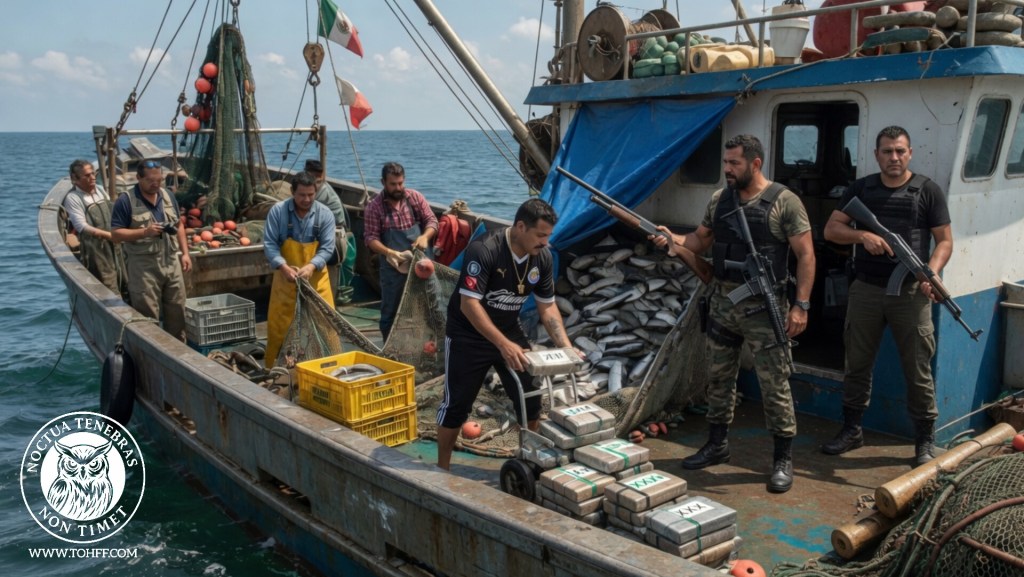
When we envision organized crime, our minds usually drift to dimly lit back alleys, slick corporate boardrooms, or encrypted dark-web marketplaces. We rarely look to the open ocean. Yet, far out at sea, where national jurisdictions blur and law enforcement is stretched thin, lies one of the most lucrative, dangerous, and geopolitically compromised frontiers on the planet: the. commercial fishing industry.
Beyond the picturesque imagery of local fishermen hauling in the day’s catch lies a multibillion-dollar global enterprise deeply entangled with transnational crime syndicates and international espionage networks. From human trafficking and drug smuggling to black-market cash economies and naval espionage, the fishing industry has become the perfect camouflage for actors operating entirely outside the law.
To understand why the commercial fishing industry is so deeply intertwined with criminal activity, one must first look at the workforce that powers it. Commercial fishing is widely considered one of the most brutal, hazardous, and grueling
jobs on Earth. Because of the extreme physical demands, months of isolation, and low pay unless catches are good, most legitimate labor markets in developed nations have largely abandoned it. This has created a massive labor vacuum, which vessel owners frequently fill with individuals who have nowhere else to turn.
For those with extensive criminal histories, a lack of legal identification, or severe societal blacklisting, the fishing industry can offer a rare and desperate proposition: no background checks, no questions asked, immediate employment and the potential for big money.
Unfortunately, this culture of desperation easily morphs into a cycle of extreme exploitation. Syndicates prey on undocumented migrants and vulnerable individuals, trapping them at sea for years at a time through debt bondage and forced labor.
Once aboard these vessels, workers are entirely at the mercy of the captain, cut off from any hope of rescue. Because a significant portion of the workforce consists of individuals operating outside mainstream society, a culture of lawlessness becomes normalized.
On the high seas, standard labor laws, human rights conventions, and criminal codes are notoriously difficult to enforce, creating an environment where criminal behavior doesn’t just exist—it thrives. This lawless social structure is mirrored perfectly by the industry’s economic framework, which is uniquely suited to illicit financial flows.
A staggering volume of the global seafood trade operates within a shadowy parallel economy driven by Illegal, Unreported, and Unregulated (IUU) fishing. At its core, fishing is a highly volatile, high-cost business. To mitigate risks and maximize profits, many operators rely heavily on cash transactions. Fuel, provisions, and wages are frequently paid in cash at obscure ports or via mid-ocean transfers, leaving virtually no paper trail.
This total lack of financial transparency makes the industry an ideal mechanism for money laundering, allowing criminal syndicates to easily blend illicit cash from narcotics or extortion into the legitimate revenues of a commercial fishing fleet.
One of the most effective tools for sustaining this black market is a process known as transshipment. Instead of returning to port to unload a
catch—where they would face customs, quotas, and inspections—fishing boats meet massive, refrigerated cargo ships called “reefers” in international waters. They transfer their catch at sea, effectively blending legally caught fish with illegally poached, endangered, or unregistered marine life. By the time the reefer arrives at a mainstream port, the origin of the seafood is completely obscured
This black market does more than just steal billions of dollars from global economies and destroy marine ecosystems; it serves as a logistical conveyor belt for other contraband. Because fishing vessels are designed to carry tons of cargo and move undetected across maritime borders, organized crime groups use them as maritime mules.
Cartels routinely use fishing trawlers to transport cocaine, heroin, and synthetic drugs across oceans, dropping packages at coordinated coordinates for local
distributors to retrieve. From the Horn of Africa to the Mediterranean, fishing boats are also frequently intercepted carrying illegal firearms or functioning as overcrowded, hazardous transport vessels for human smuggling rings.
While organized crime exploits the fishing industry for financial gain, sovereign states and intelligence agencies exploit it for geopolitical leverage. For decades, spy agencies have recognized that a fishing trawler is the ultimate civilian disguise. A naval warship sticking its nose near a rival country’s coastline is an act of aggression; a commercial fishing boat doing the exact same thing is just trying to catch tuna. This plausible deniability makes fishing fleets incredibly valuable assets for espionage, and intelligence agencies use them in several sophisticated ways.
Many modern “fishing” vessels are retrofitted with advanced hydrophones, radar scanners, and signals interception equipment hidden beneath the deck. While the crew throws out nets on the surface, the technology below is busy mapping the ocean floor, tracking submarine acoustic signatures, or intercepting military communications. In some regions, nations have formalized this overlap by employing “maritime militias”—fleets of ostensibly commercial fishing vessels that are actually funded, trained, and directed by the military. These boats are used to swarm disputed waters, bully foreign coast guards, and assert territorial without ever firing a shot or technically deploying a navy.
This is not a new tactic. During the Cold War, both the CIA and the Soviet KGB routinely utilized modified fishing vessels to deploy divers, monitor underwater nuclear tests, and shadow enemy naval maneuvers. If caught, the respective governments could simply claim the vessel was an independent commercial operator that had unfortunately drifted off course.
The mechanics of using massive, industrial maritime vessels as fronts for high-stakes espionage has been a staple of the intelligence community for generations, perhaps most famously mirrored in historical operations like Project Azorian, where the US government staged an entire deep-sea mining venture just to raise a sunken Soviet submarine from the ocean floor.
The nexus between fishing, crime, and espionage persists because the high seas suffer from a profound governance deficit. The oceans cover over 70% of the Earth’s surface, making effective policing a logistical impossibility for any single nation. Once a ship enters international waters—beyond the 200-nautical-mile Exclusive Economic Zone (EEZ) of a coastal state—it enters a legal gray zone.
This vulnerability is further exploited through the use of “Flags of Convenience.” For a small fee, vessel owners can register their ships in countries with notoriously lax regulations and zero oversight, such as Panama or Vanuatu. This allows them to obscure their true identities, shield themselves from taxes, and avoid criminal liability entirely.
Ultimately, the global seafood industry is vital to feeding billions of people, but its dark underbelly can no longer be ignored. It is an industry where the desperate and the lawless find employment, where cash and black markets dictate the economy, and where international spy agencies play highstakes games of geopolitical chess.
As long as the world demands cheap seafood and tolerates opaque supply chains, the oceans will remain the perfect playground for pirates, cartels, and spies.
The next time you see a commercial trawler silhouetted against the horizon, remember: what is visible above the water is only a fraction of the story.
Book on Amazon!
Intelligence Gathering: Front Line HUMINT Considerations
The things I talk about in this book are double-sided; can be used to
target others or used against you.
Audio Book @ https://www.amazon.com/dp/B0DJMW8SM5
Kindle @ https://www.amazon.com/dp/B086WPL4XS
Paper Back @ https://www.amazon.com/dp/B086PN2KLQ
Hard Cover @ https://www.amazon.com/dp/B0FK25TC7D

