
I would say the firearm I have encountered the most in the security business internationally is the shotgun. I have heard many supposed experts within the close protection industry dismiss shotguns as being “cowboy” and “overkill” and not having an application. Personally, I would strongly question the experience of these experts.
Over the last 30 years I have worked commercially in the security and firearms business in Europe, US, Africa, Middle East, Caribbean, and Latin America. I have encountered shotguns being used in all locations where firearms are legally employed for security and defensive purposes. There are pros and cons to shotguns as there are with all firearms that need to be understood, and I will try to explain a few of the main points in this article.
In many places where firearms are allowed to be used in the legal security industry the first firearms you tend to come across is the shotgun for a number of reasons. Shotguns are primarily seen as sporting guns with recreational applications for clay pigeon shooting and hunting. So, they are usually legal to some extent in most countries, which makes it easier for them to be included in any armed security industry regulations.
Even though shotguns are extremely effective weapons they have limitations and are generally not classified as military type weapons due to their limited range, rates of fire and tube/magazine capacities. In many places’ restrictions are placed on the barrel lengths so the guns cannot be shortened and made concealable.
Also, restrictions are placed on the types of ammunition that’s available and legal for use which can limit the guns range and lethality. In simple terms, shotguns are not the type of firearms you’re going to be overthrowing a government with and are not really in the same league when compared to assault rifles for general combat applications.
Shotguns are relatively easy to use, durable and very affordable when compared to handguns which is a major factor when equipping a guard force. The various types of ammunition available for shotgun can greatly affect the weapons lethality, I will talk more about this later, but will say here that I have come across many guards carrying birdshot shells in their guns, which can be lethal at close quarters, but at any distance will just hurt and piss off the bad guy you’re shooting at.
As with all firearms, if you’re using them, you must understand the gun, the ammunition, their limitations, and applications.
The Guns
Shotguns come in various configurations and if your serious about working in the international security industry you should be familiar with how to at least unload and make safe all the firearms you could come into contact with. There are three main types of shotguns, which I will talk about.
- Break Barrel: These are the guns most people will visualize when shotguns are mentioned, the iconic “Double Barreled” shotgun. The break barreled shotguns come either with side-by-side or over-and-under barrels, and some companies are even offering tripled barreled shotguns. In some places break barreled shotguns are the only firearms that are legally available to the general public, so you should know how to operate them. They are generally simple to use, and most models are very similar but what can vary greatly is the price, with high-quality guns costing tens of thousands of dollars. Even though many would dismiss them as not having any security applications, I will say that if they are loaded with the right shells, they are as deadly as any other shotgun. Sawn-off double-barreled shotguns have been a criminal’s favorite firearms for a long time and in the right hands they are a devastating weapon.
- Pump Action Shotguns: There are a lot of myths that surround the use of pump action shotguns that can end up getting people into a lot of trouble or killed, so ensure you learn how to use them from an instructor who has actually worked with them and not just been instructed on how to instruct classes on them. Pump action shotguns come in a variety of configurations and what can vary greatly is the location of the safety catches and the action releases. Good quality and well-maintained pump action shotguns are very reliable as the shells are cycled through them manually by the pump action. If someone can handle and control the guns properly, then double tapping and rapid fire is not a problem.
- Semi-Automatic Shotguns: In the last few years there have been big improvements in the reliability of semi-auto shotguns. A game changer was the introduction of the Russian Saiga 12 that was originally introduced in the West as a sporting gun and has since been made tactical and copied by other manufactures. The Benelli M4 is an excellent semi-auto that is in service with quite a few militaries and police units globally, but the issue with this gun is the price tag that generally runs over $1500.00 USD (MSRP $1999.00 USD). One of the best semi-auto shotguns of all time is the Browning A5 that was designed in 1898 by John Browning and officially saw services with various militaries and police units from 1905 until 1975, I think it was used in Rhodesia until the end of the war in 1979. One of the main things that can cause malfunctions with semi-autos is the type of ammunition being used, generally they prefer “hotter” loads to ensure there is enough force and gas to enable the guns to cycle properly.
Barrel Lengths, Chokes, Tubes & Mags
There are many myths about shotguns, and I can’t dispel all of them here, but one of the main ones I hear all the time, which is complete bullshit, is that you cannot miss with a shotgun… You can miss with any gun! I have seen people miss targets at 2 meters, 35 meters and everything in between.
Shotguns generally fire a certain number of pellets per shell but can also fire solid singular slugs. When firing shells containing pellets it takes distance for the pellets to spread out after the shell has been shot, so up close the barrel of the gun needs to be directly on your target. As the pellets spread out the further they get from the barrel and even at say 25 meters you need the barrel centered on the target for the majority of the pellets to hit.
Also, if the shooter is not controlling the gun properly the recoil, especially with pistol grip guns or when using “hot” loads can throw the gun off its aim causing a complete miss. If you are using slugs the same principals apply as if you were using a rifle as the shells contain one projectile.
If you are using a shotgun you need to understand how the gun “patterns” with the ammunition that you’re going to be using. To “pattern” a shotgun you need to shoot targets at various ranges, say 5, 10, 15 and 25 meters to see how the pellets spread out and pattern. You will then know the area your pellets will cover when shot at different distances. All guns tend to shoot differently with different types of ammo. I have seen very similar shotguns shoot completely different patterns as the shooters were using different brands of ammo with the same loads.
Things that effect how the shotguns shoot and pattern are the barrel lengths, the chokes and the types of ammo being used. I will stick my neck out and say as a general rule, a US legal 18-inch barreled shotgun with no chokes, should be able to put all 9 pellets from a standard 2 3/4”, 00 Buckshot shell on a silhouette target at 20 meters… After this distance and maybe before pellets will be straying off target, which means they could fly and hit innocent bystanders etc.
Personally, I think of a shotgun at distance as an area weapon that’s ideal for putting down suppressing fire out to 50 meters and beyond. If you have the available shooting ranges, try patterning your gun beyond the textbook effective ranges for shotguns and think about how they can be applied tactically. A 4-meter pattern of #4 buckshot at 100 meters should keep someone’s head down to say the least!
- Gauges: The most common gauge or caliber for shotguns in the security world is 12 gauge (12ga). For those looking for a defensive shotgun and find the recoil of the 12ga too much try 20ga. Another common gauge or caliber is 4/10 which is very easy to shoot and should be OK for frail people and children. The smaller the gauges mean the shells will hold smaller powder charges and less pellets.
- Barrel lengths: The general rule is the shorter the barrel of the shotgun the quicker the pellets from a shell will spread out when fired. To put it simply, short-barreled shotguns are for close quarters, longer barreled shotguns are primarily sporting guns for shooting clay pigeons and hunting, but all are equally lethal. Most shotguns used for security applications have barrel lengths from 18 to 20 inches. You should always check the legal required length for a shotgun barrel in the areas you’re working. Sawing a few inches off the barrel of your 870 might make it a lot handier but could also get you sent to jail!
- Chokes: The easiest way to describe what a choke does is to say that it narrows the muzzle of the barrel slightly which constricts and focuses the spread of the pellets. Tactical and defensive shotguns usually don’t have any chokes in the barrels, but sporting guns can come with various chokes; Cylinder (no choke), Improved, Modified and Full. Hunters and sports shooters can vary the chokes they use depending on the distances there are shooting. From a safety perspective there can be issues shooting slugs through barrels with full chokes, always check what the gun and ammo manufacturers recommend, you don’t want to end up hurting yourself or more importantly damaging a good gun because of your negligence!
- Tubes & Magazines: On a pump action or semi-auto shotgun the “tube” is the magazine tube that runs under the barrel and holds the shells that are going to be shot. The number of shells a gun can hold will depend on the length of the barrel, the size of the shells and if there are any legal restrictions. Generally, a pump action tactical/security shotgun should hold between 5 to 7 shells in its tube and one round in the chamber. When unloading a pump action or semi-auto shotgun that has a magazine tube ensure you always check the tube is empty; with the action of the gun to the rear you can have an empty chamber, but if there is a round in the tube, as soon as the action goes forward, you would have reloaded the gun. ALWAYS CHECK THE TUBE WHEN UNLOADING! There are also various shotguns these days like the Saiga 12 that load from conventional under the gun magazines, the only issue I have with these is that anything past a 5 round magazine can be very bulky and awkward to use in small spaces. There are some 20 round drum magazines on the market that seem to work fine which I can see security and anti-drone applications for.
- Accessories: Personally, I am not a fan of people decorating their shotguns and firearms like a Christmas tree with tacticool accessories. If your using slugs to hunt game at distance, then I see the relevance for a scope or optic on a shotgun to ensure a clean kill. Tactically, there is no need for optics on shotguns, they are just another gimmick… Flashlights are cool in the case you drop your car keys or the like in the dark or you want to show the bad guys where you are so they can shoot you first, but that’s about it… Keep it simple, keep it real and spend your money on ammo and learning to shoot!

Shotgun Ammunition
One of the main advantages of shotguns is that they can fire a wide variety of ammunition for defense, hunting or sporting applications. With a 12ga shotgun you can literally shoot clay pigeons, real pigeons, deer, bears, pedophiles, and terrorists, you just need to choose the right type of shells.

The ammunition used in shotguns is referred to as shells, not bullets. Shotgun shells come in various sizes but the most common for 12ga guns are 2 ¾ inches, 3 inches and 3 ½ inches. Most modern 12ga shotguns are chambered for 2 ¾ inch and 3-inch shells but some older guns only take 2 ¾ inch shells. The size of the shells the guns are chambered for is usually marked on the barrels and most guns from the main manufacturers have barrels that can be easily taken off and changed. 3 ½ inch shells are usually only used for sporting applications such as duck or geese hunting.
Shotgun shells are made up of the shell case, a primer, powder charge, a wad and the shot or slug. These days most shells are plastic as are the wads, but there are still some shells on the market with cardboard wads. The wads separate the powder charge from the pellets ensuring the gases from the powder are contained when the shell is fired. Plastic wads these days usually have a cup for the shot that opens up when it exits the guns barrel.

I am going to detail a few of the main types of ammunition here that can be used for tactical/security applications. In some locations there are restrictions on some types of ammunition, all I can say is work with what you’ve got and learn how to use it to maximum effect. There are things you can do to modify shotgun shells to make them more lethal, but this can also affect how the shells shoots and can also be illegal, so I advise people to stick to factory ammo, its deadly enough!
Note: In the below photos a 9mm round is shown for scale
000 Buckshot: In terms of size one pellet of 000 Buckshot is .36 caliber (9.1MM) and averages 8 pellets in 2 3/4″ shells and 10 pellets in 3” shells. So, hitting someone with a 3” shell of 000 buck is like shooting them 10 times with a 9mm pistol.

00 Buckshot: This is the most popular tactical load for shotguns with 9 pellets of .33 caliber (8.3MM) in 2 3/4″ shells. In the larger 3” shells there is on average 15 pellets.

#4 Buckshot: This is a common tactical load, and one pellet of #4 buckshot is .24 caliber (6mm) with an average of 27 pellets in 2 3/4″ shells and 41 pellets in a 3” shells with velocities of around 1200 feet per second. This is a devastating defensive load and can also be used for hunting medium size deer and game etc.
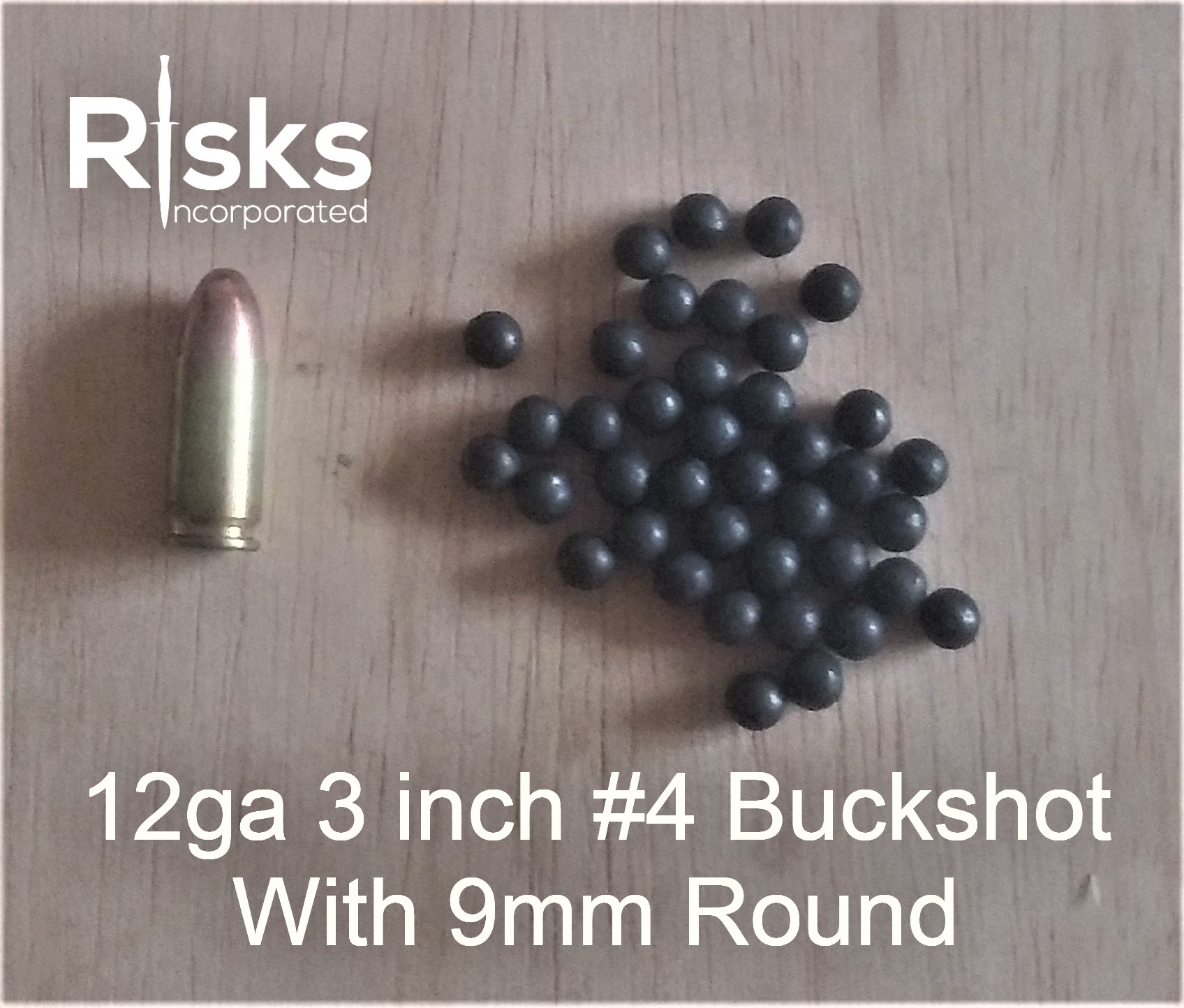
T-Shot: This load is generally used for hunting geese and foxes etc. but is also excellent for defense or tactical applications. One pellet of T-Shot is .20 caliber (5mm) with an average of 50 pellets in a 3” shells with velocities of around 1300 to 1500 feet per second. It can be very difficult to find, if not impossible, T-Shot in 2 3/4″ shells as it is primarily a hunting caliber but is also a devastating defensive load, especially with steel shot.

BBB: This is another load that is primarily used for hunting ducks and geese but is also a good defensive load. One pellet of BBB is .19 caliber (5mm) and there is an average of 65 pellets in a 3” shells with velocities of around 1400 to 1550 feet per second.

Birdshot: In quite a few countries birdshot is used for riot control as at distance it will hurt people, but the pellets do not have the weight to penetrate and cause permanent damage unless someone is hit in the eyes. One 3” shell of #4 birdshot can hold over 130 pellets of .12 caliber (3mm). I have seen security guards in several countries carrying bird shot in their shotguns, most probably because its cheap and they don’t know the difference between one shotgun shell and another.
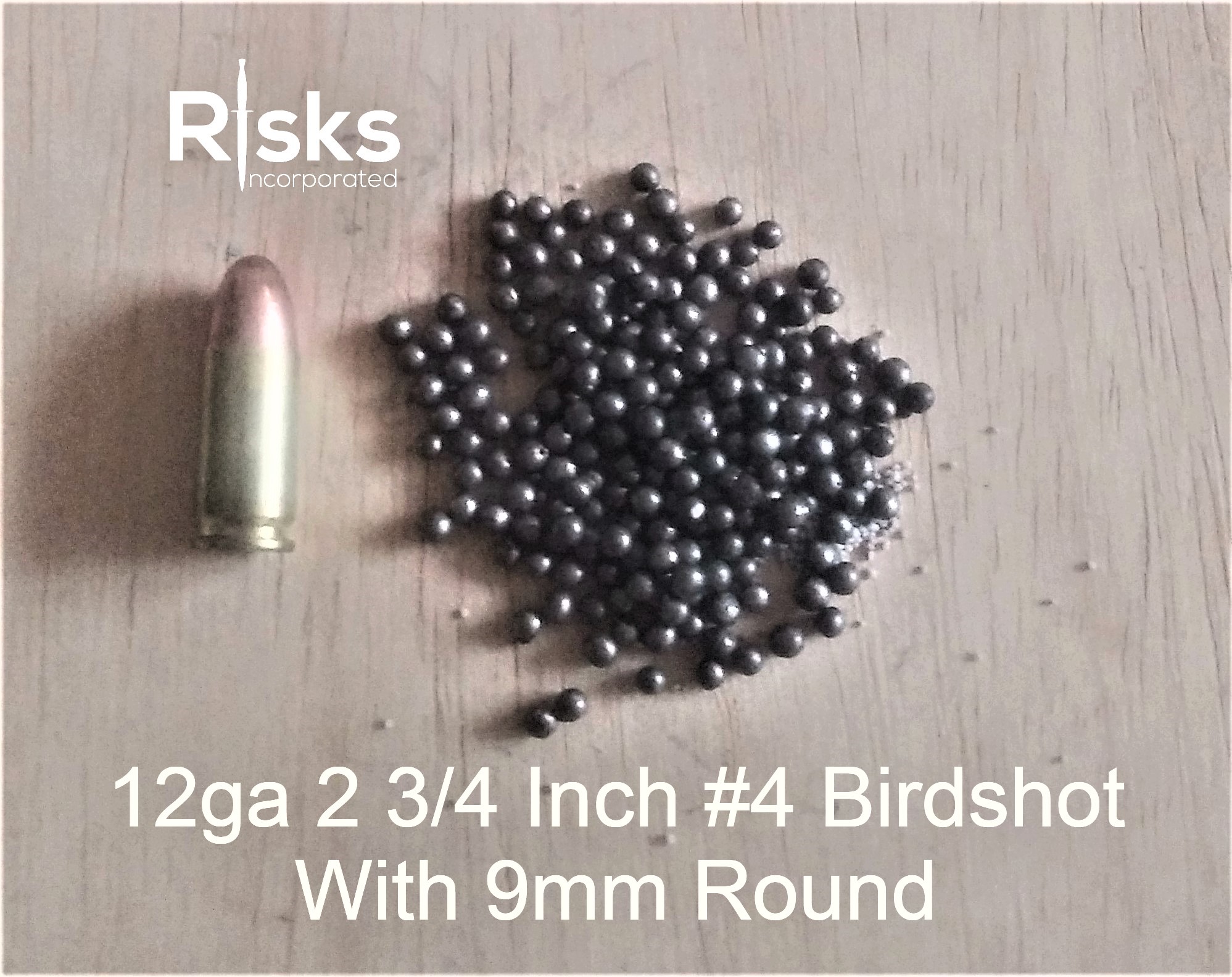
Slug: The primary use for slugs is hunting big game such as boar, deer and elk etc.and can reach out to distances beyond 300 meters. Shotgun slugs have been romanticized by special forces using them as an option to blast off door hinges and zombie apocalypse computer games. For tactical applications if you hit someone with a solid lead or copper hollow point slug they are going to have big problems but my opinion is shotguns are scatterguns, and if you want to shoot single projectiles use a rifle as they are more accurate and carry more ammo. A 30 round AK-47 magazine is smaller than an 8 round Saiga 12 magazine. If rifles are not legal and you need to deal with targets at distance then slugs are an option, but I would personally mix them up with other loads to have options for all situations.

Exotic: There are a lot of “exotic” rounds on the market, many of which are just gimmicks and are OK to talk about at the bar or showoff on a range. For tactical and defensive applications use reliable and tested ammo not something that looks cool on YouTube.
There are many more shotgun loads and pellet sizes, these I feel are the main one’s worth talking about in a short article. As I said above, shotguns to me are scatterguns and can put out a lot of pellets very quickly with devastating effect if the shooter can handle the gun properly.
In an under-and-over shotgun that I had professionally cut to just over the legal US barrel length of 18 inches (18.25 to ensure it was legal) I use to load 3” shells of T-Shot. The gun was compact and for home defense etc., and could put down 100 .20 steel pellets traveling at 1500 feet per second as quickly as I could pull the trigger… Up to 10 meters that gun, with that load, it would shred a bad guy, and at 50 meters and beyond, would be causing pain and keeping peoples heads down.
I am a big fan of shotguns for tactical and security applications but with any firearms the user must know how to use them and ensure they are well maintained. There are many other things that need to be considered when working with shotguns and firearms in general that cannot be learned from a book or a video, so get professional and reality-based training, practice with your firearms and remember to keep your drills simple and real!
Books on Amazon
Tactical Pistolcraft for Protective Operations
A Real-World Guide for Concealed Carry & Armed Security
In this book I aim to dispel some of the myths and highlight the realities of the armed close protection and security industries.
Kindle @ https://www.amazon.com/dp/B0FPGGLDBK
Paper Back @ https://www.amazon.com/dp/B0FPM28RS3
 Truth Only Has Few Friends